
Marketing for Service Businesses: The Full System
Tried marketing and decided it doesn't work for a business like yours? The fix is usually a system, not another one-off tactic. Here's how the five pieces fit together.
You've tried marketing before. Maybe you boosted a few posts on Facebook. Maybe you paid someone to "do SEO" for a while, or sent out a batch of mailers.
And when it didn't bring the flood of new clients you hoped for, you quietly filed marketing under "doesn't really work for a business like mine."
We hear that a lot, you know. And yes, we do understand the pain.
But the problem is rarely the tactic you picked. What's missing is everything around it: the follow-up, the website, the other pieces that turn a flicker of interest into a booked job. Marketing for service businesses works when those pieces connect. Run on their own, they mostly leak.
This is the strategic overview, the full picture rather than any single channel. We'll walk through why service businesses are different, why lone tactics disappoint, the five pieces that make up a working system, and how to start without trying to do everything at once.
Why Marketing for Service Businesses Works Differently
When you sell a product, people can see it, compare it, and know what they're getting before they buy.
A service is different. You're asking someone to trust a result they can't hold or inspect ahead of time.
That changes how marketing for service businesses has to work. The decision is slower and more personal. People read reviews, ask around, and look you up before they ever call. What they're weighing is whether to trust you with something that matters to them.
That's why trust signals do the heavy lifting here. Reviews, a professional website, clear answers to the questions people quietly worry about. Those carry more weight than a clever slogan ever will.
Service businesses also share an acquisition model that shapes the whole approach. Customers search locally. They book appointments rather than adding to a cart. A single client can be worth thousands over time. And the person deciding is usually the owner, at the end of a long day.
So the marketing that works here leans on trust and local intent, not clever product ads. Show up where people search, prove you're credible, make the next step easy, and stay in touch. That's the shape of it.
Why One Channel on Its Own Usually Disappoints
Here's where most marketing money quietly drains away. A single channel, run in isolation, rarely performs the way the sales pitch promised. Each channel gets sold as a complete answer, and none of them is. The channel usually works fine. It just can't carry the whole job by itself.
Picture the common versions of this:
- Ads with nowhere to land. You pay for clicks, they hit a slow or vague website, and most visitors leave. The ads worked. The page didn't.
- SEO with no follow-through. You climb the rankings, people find you, and then nobody answers the phone or replies to the form for two days. The lead already booked someone else.
- Reviews you never ask for. Your service is great, but your listing shows three reviews from years ago, so a new customer picks the competitor with fifty recent ones.
- Social posts into the void. You post regularly, get a few likes, and none of it turns into a booking, because there's no path from the post to actually hiring you.
None of those channels is worthless. Each one just needs the others to finish the job. That's the whole argument for a system.
The Five Pieces of a Service Business Marketing System
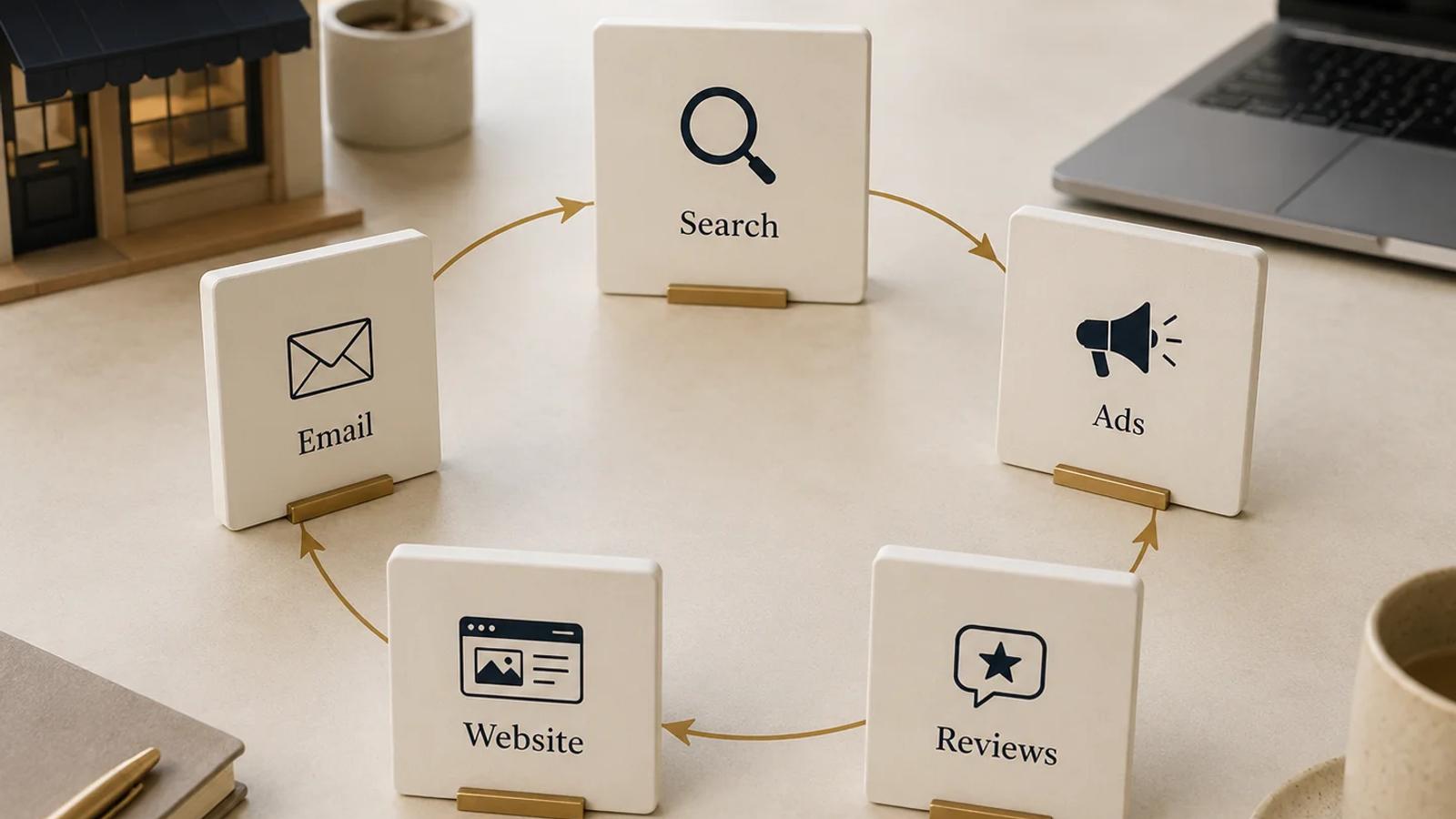
A working system for a service business comes down to five pieces. You don't need all five running at full tilt on day one, but you do need to know how they fit together.
1. Getting Found (Local Search and Your Google Business Profile)
Before anyone can hire you, they have to find you. For a service business, that starts with local search and your Google Business Profile, the free listing that puts you on the map at the top of local results. It's usually the highest-return place to begin, and it's the front door everything else depends on.
Get this right and even a small ad budget or a plain website performs better, because you're showing up for people who already want what you sell. Our local SEO guide walks through exactly how.
2. Capturing Demand Right Now (Paid Ads)
Local SEO builds over months. Paid ads work today. When someone searches "emergency plumber" or "botox near me," a well-run Google or Meta ad puts you in front of them at the moment they're ready to book.
Ads are the fastest way to switch on demand, especially while your organic presence is still growing. The catch is that they only pay off if the click lands somewhere that converts, which is piece four.
3. Earning Trust (Reviews and Reputation)
For a service, reviews are the closest thing to a guarantee a stranger can find. A steady stream of recent, positive reviews does more convincing than any ad copy, and it lifts your local ranking at the same time. Ask every happy client, reply to every review, and treat your reputation as the asset it is. This is often what decides between two similar businesses when a customer is choosing.
4. Turning Clicks Into Clients (Your Website)
Every other piece sends people here, so this is where wins are made or lost. Your website doesn't need to be fancy. It needs to load fast on a phone, say clearly what you do and where, make it obvious how to book or call, and show enough proof to feel safe. A slow or confusing site quietly wastes every dollar the other pieces spend. Fix this before you pour money into ads, not after.
5. Bringing People Back (Email and Follow-Up)
Most people who find you won't book on the first visit, and most who do could come back later. A simple follow-up habit closes that gap. A quick reply to every inquiry, a nudge for the client who went quiet, an occasional email to past customers.
It's the least glamorous piece and often the highest return, because keeping a client costs far less than finding a new one. A short list of past clients is often the cheapest marketing you already own.
If you're reading this and realizing you've got two of these running and three missing, that's the most common place service businesses get stuck. A free Growth Audit will show you which pieces you have, which are leaking, and what to fix first.
How the Pieces Reinforce Each Other
Here's the part that turns a checklist into a system. The five pieces hand off to each other.
Local search and ads bring someone to your website. The website turns them into a call. Your reviews reassure them enough to actually book. Follow-up brings them back and earns the referral that feeds the top of the whole thing again. Pull one piece out, and the chain breaks somewhere.
Picture it in motion. A search brings a new client to a med spa's site, a clear page and a fast booking button turn the visit into an appointment, recent reviews reassure them they chose well, and a follow-up email six weeks later brings them back for the next treatment. No single channel did that. The chain did.
This is also why splitting the work across five different vendors so often disappoints. The SEO agency doesn't talk to the ads freelancer. Nobody quite owns the website. Email is an afterthought no one was hired for. Each piece might be fine on its own, and the handoffs between them still land on the floor.
If you're weighing who should actually do the work, our take on SEO agency vs freelancer lays out the honest tradeoffs.
One team looking after the whole chain keeps those handoffs intact. That's the thinking behind how we built Lunova: one partner running the full system for service businesses instead of five that don't talk to each other. We're straightforward about what it costs, too. Our pricing is public, and ad spend is always kept separate.
Ignore the Shiny New Tactic
Every few months there's a new platform or trick that promises to change everything. A viral app, a clever automation, whatever's loud that season. It's tempting, especially when the basics feel slow.
After years of doing this work, we can tell you what actually separates the winners. It's almost always the businesses that did the boring five pieces well and kept at them, while everyone else jumped from trend to trend.
New tactics aren't off-limits. Once your foundation is running and paying off, testing a new channel can be a smart move. The mistake is reaching for the shiny thing before the reliable pieces are even in place. Foundation first, experiments later.
Where to Start (You Don't Need All Five at Once)
Trying to launch all five pieces at once is how owners burn out and budgets vanish. Build in order instead.
Start with the foundation, the pieces that make everything else work harder: your Google Business Profile, a handful of fresh reviews, and a website that loads fast and makes booking obvious. None of that costs much, and it lifts the return on anything you do next.
Then add one way to bring people in. If you need clients this month, that's usually paid ads. If you can play a slightly longer game, it's local SEO. Get one working before you add the other.
Layer in follow-up once leads are coming, so none of them slip away. That's the order: foundation, then demand, then retention.
On budget, be realistic rather than cheap. Marketing for service businesses rewards steady, consistent investment over a big one-month splurge. Spend enough to run one or two pieces properly instead of spreading a tiny budget across all five and doing none of them well. If a budget only stretches to one piece done right, that beats five done badly every time.
There's a real difference between cheap help and affordable help, and it matters. Our guide to affordable SEO for small business breaks down how to tell them apart.
And give it room to work. A marketing system doesn't flip on like a switch. The foundation pieces start paying off in weeks, the search side over a few months, and the whole thing compounds from there. Judge it on the trend over a quarter, not the results of any single week. Keep any ad spend counted separately from what you pay for the work itself.
Making Marketing for Service Businesses Actually Work
If marketing has let you down before, the reason is usually the same. One piece was doing the job of five. The fix is a system where the pieces connect and carry a customer from finding you all the way to coming back. Each piece is ordinary on its own. Together, they're the difference between marketing that drains you and marketing that pays you back.
Start with the foundation, add one way to bring people in, then keep them coming back. Build it in that order and give it time to compound. That's what marketing for service businesses looks like when it's working.
If you'd rather not assemble it piece by piece yourself, that's what we do, one partner for the whole system instead of five. Our free Growth Audit is the simplest place to start. We'll map what you've got, what's missing, and what to fix first. You're also welcome to browse our other guides for owners and take what's useful.
Frequently Asked Questions
How much should a service business spend on marketing?
There's no single right number, and be wary of anyone who hands you one without knowing your business. A steadier, smaller budget spent consistently beats a big one-off push. Aim to fund one or two pieces properly rather than spreading a little across all five. And keep any ad spend counted separately from the cost of the work itself.
What's the most effective marketing for a service business?
For most local service businesses, the highest-return starting point is local search and your Google Business Profile, backed by a steady flow of reviews. It puts you in front of people already looking for what you do, at the moment they're ready to act. From there, the best mix depends on your goals and timeline.
Do service businesses need social media?
Less than you'd think. Social media can support trust and keep you visible, but for most service businesses it's rarely the piece that books appointments. If you're stretched, get found in local search, gather reviews, and sharpen your website first. Add social once the foundation is solid.
Is email marketing worth it for local businesses?
Often, yes, because it's how you bring people back. A simple follow-up to past clients and quiet leads costs almost nothing and keeps you top of mind for the next time they need you. Keeping a client is far cheaper than winning a new one, and email is the easiest way to do it.
How do I market my business on a small budget?
Start with what's nearly free and high-impact. Complete your Google Business Profile, ask every happy customer for a review, and make sure your website loads fast and makes booking obvious. Those three moves cost little and lift everything you do later. Add paid channels once the foundation is earning its keep.
This article is for general informational purposes only and is not legal, medical, or professional compliance advice. Advertising rules for regulated professions vary by state and licensing body and change over time. Consult your state bar, licensing board, or a qualified compliance professional before running campaigns in a regulated field.