
Top 8 Gym Marketing Strategies After the January Signups Lapse
January fills the gym. March empties it. Most gym marketing solves the wrong problem. Here's how to build a system that handles both acquisition and the retention economics that actually determine revenue.
January fills the gym. You know what happens next. By March the floor looks like October, the signups have trickled to nothing, and the marketing budget is already being pointed at next January. The cycle repeats, the membership base stays flat, and the revenue never compounds the way it should for a business built on recurring fees.
The problem isn't acquisition. It's that most gym marketing is built entirely around the surge and has nothing in place for the drop. The strategies below address both ends: getting the right members in and keeping them past month two.
8 Gym Marketing Strategies That Work After January
These aren't ranked by importance. The order follows the member lifecycle, from the first search to the moment someone almost cancels. A few of these are acquisition plays. Most are retention plays dressed as marketing. All of them are things the average independent gym skips.
1. Fix Your Google Business Profile Before Anything Else
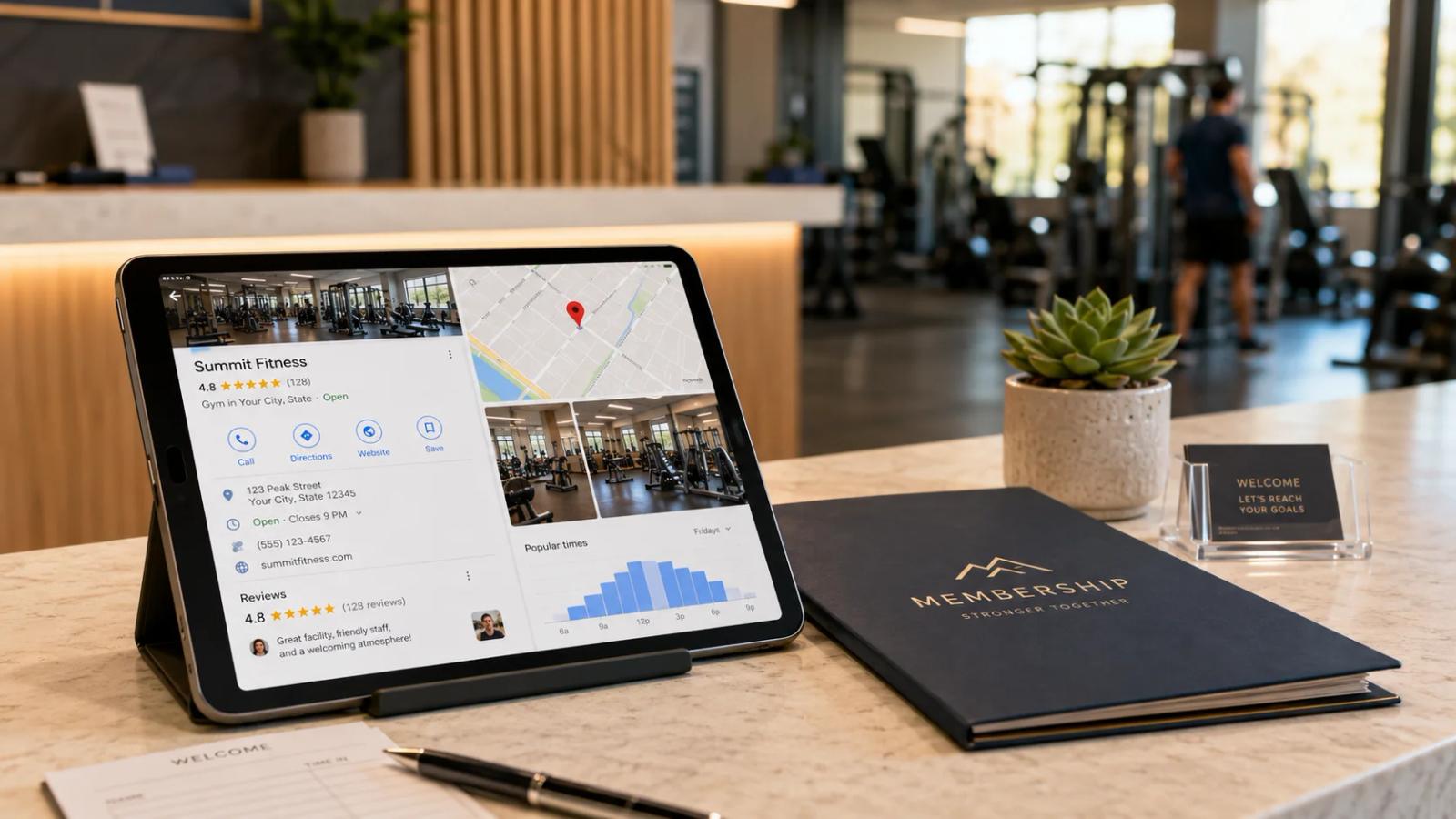
For most gym-related searches, your Google Business Profile (GBP) does more work than your website. The map pack appears before organic listings on nearly every "near me" query, and the gym that shows there with accurate hours, current photos, and a real review count has a significant edge.
The thing most gym owners miss: categories. "Gym" is a category. So are "Fitness center," "CrossFit gym," "Personal trainer," "Yoga studio," and dozens of others. Setting only the primary and leaving secondary categories blank is one of the most common reasons gyms go invisible on the specific searches they should be winning.
A complete GBP also means responding to reviews, keeping photos updated, and using the Q&A section before your competitors do. Our GBP optimization service covers exactly what a fully configured profile looks like for fitness businesses.
2. Target the Searches You Can Actually Win
Ranking for "gym near me" is a fight against Planet Fitness, Anytime Fitness, and every other chain with thousands of locations and reviews. Independent gyms rarely win there. The searches they can win are the specific ones.
"CrossFit gym near me." "Strength gym near me." "No-contract gym near me." "Gym for beginners." "24-hour gym near me." These carry real intent, lower chain competition, and a buyer who's already filtering toward something specific.
Each of those searches deserves its own page, built around what that searcher needs to understand at that stage. A homepage trying to be everything to everyone doesn't convert the person who searched "powerlifting gym near me" — a dedicated page does. This is the core of what local SEO for small businesses actually looks like in practice.
3. Market the Fit, Not the Price
The cheapest gym offer attracts the most price-sensitive members. Price-sensitive members are also the first to cancel when motivation drops or something cheaper comes along. Gym marketing built around "lowest price" or "no enrollment fee" optimizes for volume at the cost of member quality. Member quality is a retention variable before anyone ever walks in the door.
Marketing built around what your gym is specifically for attracts members who joined for the right reasons. A member who found you searching "women's gym with no mirror culture" has specific motivation that matches what you offer. That specificity is an asset. A member who came in on a $1-first-month deal has no such anchor.
The creative test: if your ad could run for any gym in your city without changing a word, it's too generic. The ad that works describes something only your gym does.
4. Build a First-30-Day Email Sequence
Month-one churn is real and preventable. A new member who visits twice in their first two weeks and then goes quiet for ten days is almost certainly on their way out. The intervention window is short.
A simple email sequence through the first thirty days changes this. Day two: welcome, what to expect from the first week. Day seven: a check-in with answers to common questions. Day fourteen: acknowledge they've made it two weeks, give them something to focus on next. Day twenty-eight: mark it as a milestone, not just another email.
None of this is complicated. Most gyms don't do it because nobody owns the follow-up. Making it automatic removes that dependency entirely. The sequence doesn't need to be sophisticated; it just needs to exist.
5. Build a Referral Program With Actual Mechanics
Word of mouth is already the best acquisition channel for most independent gyms. Referrals arrive pre-sold, convert fast, and cost almost nothing to acquire. The gap is that most gyms rely on organic referrals rather than systematic ones.
A member who loves your gym will mention it if someone asks. They won't proactively recruit a friend without a reason. A referral program with real mechanics changes that: a specific offer, a simple way to share it, and an acknowledgment when it converts.
The mechanics don't need to be elaborate. A referral link, a perk for the referring member, and a frictionless path for the new person to join. The value is in making it easy and repeating the ask at the right moments, not in building a complex incentive structure nobody reads.
6. Catch Fading Members Before They Cancel
The member who stops attending but keeps paying is on a thirty-to-sixty-day countdown. Most gyms don't notice until the cancellation arrives. By then the conversation is already over.
A simple attendance-based trigger changes the timeline. If someone hasn't visited in ten days, they get a message acknowledging the gap and offering something concrete: a class recommendation, a check-in with a trainer, a low-barrier reason to come back in.
This is gym marketing in the operational sense, not the advertising sense. It's the difference between treating retention as a passive result of a good product and treating it as an active output of a system. The difference in revenue between those two approaches is significant.
7. Run Paid Ads for Trial, Not for Commitment
Paid social is the channel most gym owners try first. The results are mixed, and they're almost entirely explained by the offer and the follow-up rather than the ad itself.
What works: low-friction offers that reduce the commitment required to try the gym. A free day pass, a two-week trial, a discounted first month with no contract. The goal of the ad is to get someone in the door, not to sell a twelve-month membership from a carousel post.
What happens after the first visit determines whether the ad spend was worth it. A good first-visit experience combined with an active follow-up sequence turns a trial into a member. A good first-visit experience with no follow-up produces a one-time visitor and a wasted acquisition cost. The ad is only half the equation.
Google Ads work differently. Search ads capture existing intent rather than creating it, so conversion rates tend to be higher with lower volume. For specialty gyms with a defined niche, search can be more efficient than broad social campaigns. For general fitness gyms competing on convenience, social typically builds better top-of-funnel volume.
8. Plan Marketing Across All Four Quarters
A full gym marketing calendar isn't just January ads at full intensity. It's a planned approach to each quarter that accounts for the demand cycles every gym experiences.
Q4 (October to December): build the list before the surge. Run campaigns that capture awareness among people considering a January start. Warm leads arriving in January convert better than cold ones.
Q1 (January to March): acquisition campaigns alongside the onboarding sequence for every new member. The retention system runs automatically from day two.
Q2 (April to June): the natural attrition period. Re-engagement campaigns for members who've reduced attendance. New campaigns targeting spring motivation among people who didn't start in January.
Q3 (July to September): the quiet period. Build content, improve GBP, run referral campaigns among your most loyal members, and prepare the Q4 pipeline.
Most gym marketing only runs Q1 and wonders why growth is flat. The gyms that compound revenue year over year are running something in all four windows, at different intensities, with different goals.
The Number That Changes the Math
Average membership duration is the metric that changes everything. If members stay an average of four months, a hundred new signups generate four hundred member-months of revenue. If that average extends to six months with no change in acquisition volume, revenue grows fifty percent with no additional marketing spend.
That math is why retention is a marketing problem. The gym marketing strategy that extends average membership duration by two months is worth more than any acquisition campaign run at the same budget.
The strategies above give you both sides of that equation. Acquisition that attracts the right members for the right reasons. Retention that kicks in at day two and keeps running when motivation fades. The mechanics aren't complicated; the difficulty is building all of them while running a gym.
If you want to know where your gym's marketing has the most ground to recover, the free Growth Audit will show you. No sales call attached.
Our approach to wellness marketing applies the same membership-economics thinking to boutique fitness, yoga studios, and pilates facilities. If your vertical sits closer to that side, the wellness marketing guide covers the seasonal dynamics that affect all appointment-based businesses.
Frequently Asked Questions
What's the most important first step in gym marketing?
The most important first step in gym marketing depends on where your biggest gap is. If your GBP is incomplete or your map pack visibility is weak, fix that first. It's the fastest-moving piece and affects every local search.
If acquisition is working but members are churning at high rates, build the onboarding sequence before spending another dollar on ads. The audit tells you which problem is costing you more.
How much should a gym spend on marketing?
How much a gym should spend on marketing depends heavily on membership value and how long members typically stay. A gym with a $50 monthly membership and four-month average duration is working with a very different set of numbers than one with a $150 membership and a twelve-month average.
Spending beyond a third of member lifetime value per acquisition is a signal that the retention economics need solving before the acquisition budget scales further.
Does local SEO actually work for gyms?
Local SEO works well for gyms when it's built around specific search intent rather than generic terms dominated by chains. Ranking for "gym near me" is a difficult fight against Planet Fitness and Anytime Fitness.
Ranking for "CrossFit gym near me," "strength gym near me," or "no-contract gym near me" is achievable for most independent gyms with properly structured pages and a fully configured GBP. Specificity is exactly what local SEO rewards.
Should gyms use Instagram or focus on Google?
Gyms should use both, but for different objectives. Instagram builds community awareness and keeps existing members engaged, which has real retention value. Google and local search capture active intent from people currently looking for a gym, which has higher direct conversion value.
The mistake is treating social as the primary acquisition channel while neglecting the search infrastructure that captures people who have already decided to join a gym and are just choosing which one.
What's the most common gym marketing mistake?
The most common gym marketing mistake is spending heavily on January acquisition campaigns with nothing in place for what happens next. The acquisition cost is paid in January. The churn arrives in March. That gap is almost always an engagement and follow-up problem, not an acquisition problem, and it's the part of gym marketing that most owners never address.