
SEO Packages for Small Businesses: What to Look For (and What to Avoid)
Three agency proposals in your inbox and no idea which one is actually worth anything. Here's how to read an SEO package like someone who's bought one before — what should be there, what's a red flag, and what questions to ask before you sign.
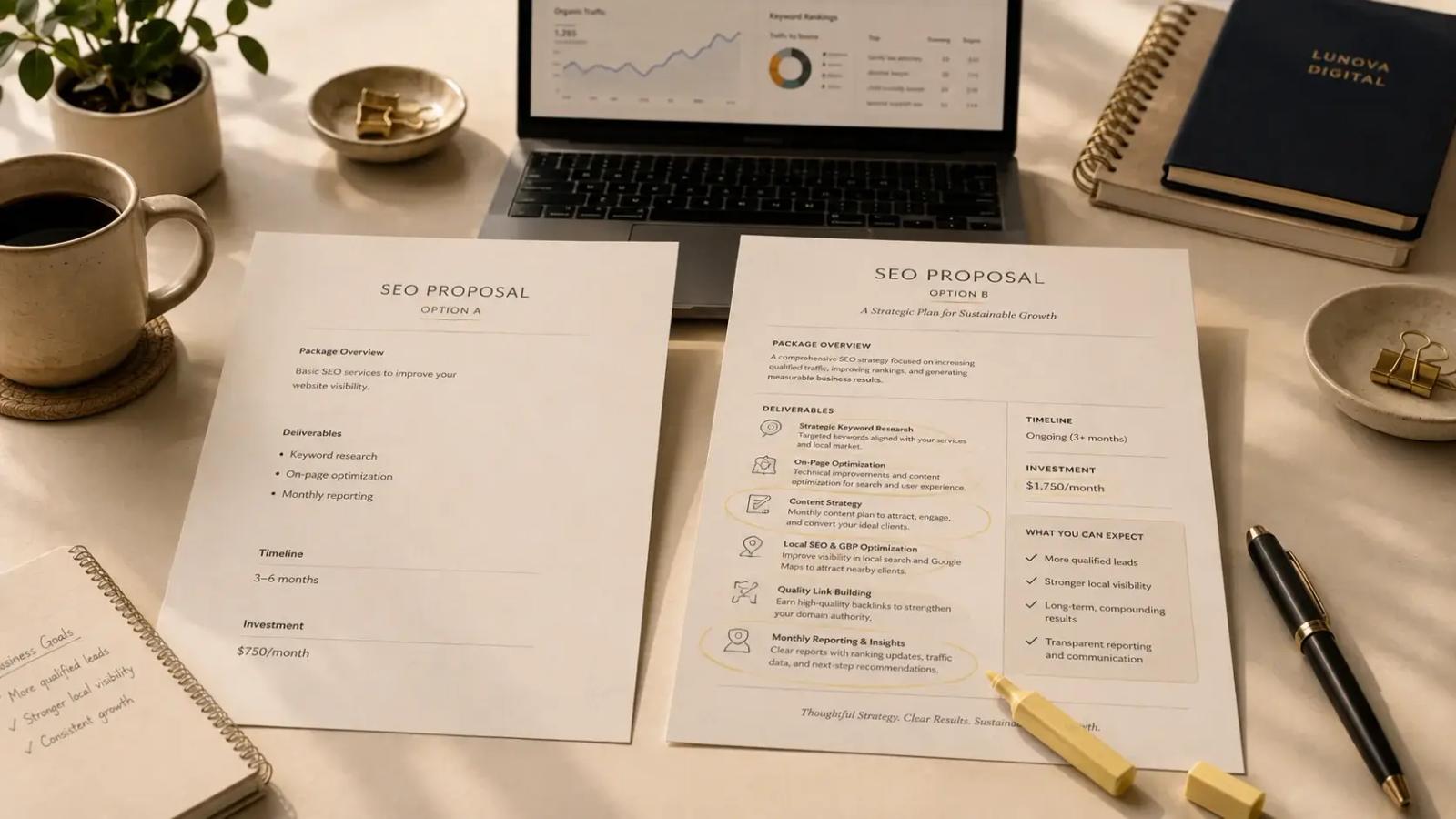
You've got three agency proposals open in separate tabs. One is $600 a month. One is $1,800. One is $3,200. All three say "SEO package" somewhere in the header. None of them make it obvious what you're actually getting for the difference.
This is the normal experience of shopping for small business SEO packages, and it's genuinely hard to evaluate without a frame of reference. Agencies use different terminology, different deliverable formats, and different definitions of what counts as "included."
This guide gives you that frame. Here's what a real SEO package for a small business should contain, what the proposals that look good but aren't actually worth it tend to look like, and what to ask before you sign anything.
What's Inside an SEO Package
Before comparing packages, it helps to understand what you're buying. SEO is not a single thing. It's a collection of activities that, done consistently over time, improve where your business shows up when someone searches for what you do.
A legitimate SEO package for a small business typically bundles some combination of these five components.
Technical SEO. Page speed, mobile usability, indexing, site structure, and fixing errors that prevent Google from reading your site correctly. Most small businesses need a one-time technical audit followed by periodic maintenance, not an ongoing monthly rebuild.
On-page SEO. Title tags, meta descriptions, headings, internal linking, and keyword placement on individual pages. This is where most small business websites have obvious gaps: service pages with no target keyword, titles that say "Home" instead of the actual service name.
Local SEO. For service businesses, this is usually the most important component. Google Business Profile (GBP) management, local citation building, location-specific landing pages, and review generation all fall here.
This is what drives map pack visibility, and map pack clicks convert at a higher rate than almost any other traffic source. Local SEO pricing breaks down what this piece costs on its own if you want that detail separately.
Content production. Blog posts, service pages, and locally relevant articles. Content is what earns organic rankings over time. A package with no content component is hoping your existing pages are good enough. For most small businesses, they're not.
Link building. Earning links from other reputable sites. This matters more in competitive categories and less in low-competition local markets. Not every small business SEO package needs heavy link building, but none should pretend links don't exist.
SEO Packages at Each Price Point
Most small business SEO packages fall into three practical tiers. Here's what you should expect inside each one, and where the corners usually get cut.
Entry-level packages: $500 to $1,000/month
At this price, you're typically buying one or two things done consistently, not a full system. A reasonable entry-level package might include GBP management, citation cleanup, and one or two content pieces a month. That's a legitimate scope for a very low-competition local market.
What entry-level packages often omit: a real content strategy, on-page work beyond surface edits, any link building, and reporting that connects activity to actual business outcomes.
The risk isn't that these packages are fraudulent. It's that the scope is too narrow to compound in any meaningful way for most service businesses.
Standard packages: $1,000 to $2,500/month
This is where local SEO packages start to become full-system work. A standard package in this range should cover: a technical audit and fixes in month one, on-page optimization across key service pages, GBP management, two to four content pieces a month, citation building, and monthly reporting.
This tier works for single-location service businesses in moderately competitive markets. Be cautious of packages at the low end of this range that promise high content volume. Four keyword-targeted blog posts a month is real work at $1,200; twenty templated posts is something else entirely.
Growth packages: $2,500 to $5,000+/month
At this level, SEO becomes a strategic function rather than a maintenance task. Expect competitive gap analysis, location-specific landing pages, a content strategy tied to actual search data, link building as a consistent monthly effort, and reporting that connects rankings to leads and revenue.
For service businesses in competitive categories (personal injury law, cosmetic procedures, veterinary in a dense urban market) or businesses with multiple locations, this is the tier that moves the needle on hard terms.
If you want to see how these packages compare to full-service retainers, how much SEO costs across all agency types gives you the full picture.
Red Flags in Small Business SEO Packages
Cheap packages aren't the only problem. Some of the most expensive SEO packages for small businesses are also the worst value. These are the signals that tell you a proposal isn't built around results.
Guaranteed rankings. No one can guarantee Google rankings. The algorithm is not negotiable. Any agency that promises you'll rank in the top three for a given keyword within 60 days is either confused or being deliberately misleading. Pass.
High content volume at a low price. If a $700-a-month package promises 15 blog posts, the math doesn't work. Fifteen posts at that budget means $46 per post before overhead, tools, or any other deliverable. That content will be thin, templated, and unlikely to rank for anything competitive.
No mention of GBP. For local service businesses, Google Business Profile is the highest-ROI component of any local SEO package. A proposal that doesn't include GBP management as a named deliverable is either ignoring the most important local ranking factor or assuming you'll handle it yourself.
Either way, ask explicitly before signing.
Vague deliverable language. "SEO optimization," "content strategy," and "link building" are not deliverables. They're categories. A solid proposal tells you how many pieces of content, which pages get optimized, what GBP management includes week to week, and how reporting is structured.
Rankings as the only success metric. An SEO package that only measures keyword positions with no connection to calls, form fills, or bookings is optimizing the wrong thing. Ask how results get reported relative to your actual business goals before you commit.
No discussion of your vertical. A law firm has bar association advertising rules that affect what SEO content can say. A med spa is subject to YMYL content standards. A vet clinic competes differently in a suburban market versus a dense urban one.
If an agency has never asked about your vertical, your competitors, or your local market, they're running the same playbook on you that they run on every other client.
Questions to Ask When Comparing Packages
Use these questions to move from "this sounds good" to "I know what I'm buying."
What exactly ships every month? Ask for a month-one deliverable list in writing. Not categories. Not "ongoing SEO work." The specific tasks, the specific outputs, and who is responsible for each one.
Who does the work? Some agencies sell the relationship and outsource the delivery. Others have the team in-house. Neither is automatically wrong, but you should know whether the strategy conversation you're having is with the same person doing the keyword research.
How is success measured? Get this in writing before the first invoice. Rankings, traffic, calls, form fills, bookings: decide which metrics matter for your business and confirm the agency tracks and reports on those specifically.
What's the contract structure? Month-to-month versus annual both have tradeoffs. A longer commitment can make sense once you've seen the work; signing a 12-month contract on a first engagement is a meaningful risk. Month-to-month options exist across most price points and are worth requesting.
Have you worked with businesses like mine? Vertical experience isn't everything, but it's not nothing. An agency that has worked with other service businesses in your category understands the competitive landscape, the content constraints, and the conversion dynamics specific to your vertical.
How SEO Packages Fit Into a Broader System
SEO packages work best when they're connected to the rest of your marketing. Organic traffic that arrives at a poorly converting website stays a problem. High local search visibility next to a 3.1-star rating is an incomplete win.
Content that ranks but has no paid traffic amplifying it during slow periods is leaving growth on the table.
This is why many service businesses eventually outgrow standalone local SEO packages and move to a retainer model where SEO connects to paid, email, and reputation management under one coordinated strategy.
The affordable SEO breakdown covers what that progression looks like for smaller budgets. Our local SEO service explains how we structure the SEO component for service businesses specifically.
What Lunova Offers
We don't sell a single templated local SEO package, and we don't require you to buy the full stack either. Most clients start with our full-service retainer, but we also build custom scopes for businesses that only need part of the system.
That might be local SEO and paid ads only, local SEO and organic SEO only, or any combination that matches where you are right now. If you've already got email handled in-house, you don't need to pay for it through us.
Growth Essentials starts at $2,200 a month on a month-to-month basis with no lock-in. After the Growth Audit, we'll scope exactly what your business needs and what it would cost, nothing more. Ad spend is always separate from the management fee.
Reach out to Lunova today and start with the free Growth Audit. It takes about 10 minutes.
We'll tell you honestly what's missing and what a package built around your specific market and vertical would actually include. You can also review our tier breakdown on the packages page before reaching out.
The Package That Produces Results
Small business SEO packages range from $500 to $5,000 a month and everything in between. The price is a starting point, not a verdict on quality.
What separates the packages worth buying from the ones that run in place is specificity: specific deliverables, specific success metrics, specific vertical knowledge, and a specific plan for connecting SEO activity to actual business outcomes.
If a proposal can't give you those four things, it doesn't matter how well the sales call went.
Ask what ships, ask who does it, and ask how you'll know if it's working. Reach out to Lunova today, and our free Growth Audit will show you exactly where the gaps are in your current search presence and what a package built around your specific market and vertical would actually include.
Frequently Asked Questions
What should a small business SEO package include?
A small business SEO package should include at minimum: a technical audit and fixes, on-page SEO across key service pages, Google Business Profile management, consistent content production, citation building and cleanup, and monthly reporting tied to business outcomes like calls or form fills.
Link building should be part of the scope for any competitive category. If a package doesn't specify which of these components are included, ask before signing.
How much do small business SEO packages cost?
Small business SEO packages typically cost between $500 and $3,500 a month depending on scope and market competitiveness. Entry-level packages at $500 to $1,000 cover basic GBP management and limited content. Standard packages at $1,000 to $2,500 include full on-page work, content, and GBP.
Growth-tier packages above $2,500 add competitive strategy, link building, and location-specific pages. Full-service retainers that integrate SEO with paid and email start around $2,200 a month.
What's the difference between an SEO package and a retainer?
The difference between an SEO package and an SEO retainer is mostly in how the scope is defined. A package bundles a fixed set of deliverables at a fixed monthly price.
A retainer is an ongoing engagement where the work can flex based on priorities, with the agency billing for capacity or output rather than a preset list.
Most small business SEO relationships function as packages in practice, even when called retainers, because a fixed monthly scope is easier to manage and budget for at that size.
Are SEO packages worth it for small businesses?
SEO packages are worth it for small businesses when the scope matches the market and the deliverables are clearly defined.
A well-run SEO engagement compounds over time: content and rankings built in months one through six continue generating traffic and leads long after that work is done, unlike paid ads that stop the moment you stop spending.
The risk is buying a package too small or too vague to generate real output. Three months of templated content and directory submissions rarely moves anything in a competitive local market.
How long before an SEO package shows results?
An SEO package typically shows initial results within three to six months, with meaningful compounding starting around the six to nine month mark. GBP improvements can improve local pack visibility faster, sometimes within four to eight weeks of consistent management.
Organic ranking movement is slower and depends on content volume, link building, and how competitive your local category is. Agencies that promise ranking results in 30 days are not being realistic about how the algorithm works.
Can I switch SEO packages or agencies?
You can switch SEO packages or agencies, and the ease of doing so depends on your contract terms. Month-to-month agreements give you the most flexibility. Annual contracts typically include exit clauses, but leaving early often means forfeiting the remaining term.
Before signing any package, ask specifically about the cancellation terms and what happens to work product (content, links, and GBP work) if you leave. Good agencies don't hold your own assets hostage when a relationship ends.