
Digital Marketing Agency Pricing in 2026: What You're Actually Paying For
The proposal says $3,500 a month. But what does that actually buy? Here's how digital marketing agency pricing works in 2026, what's included at each tier, and how to tell if a quote is worth it.
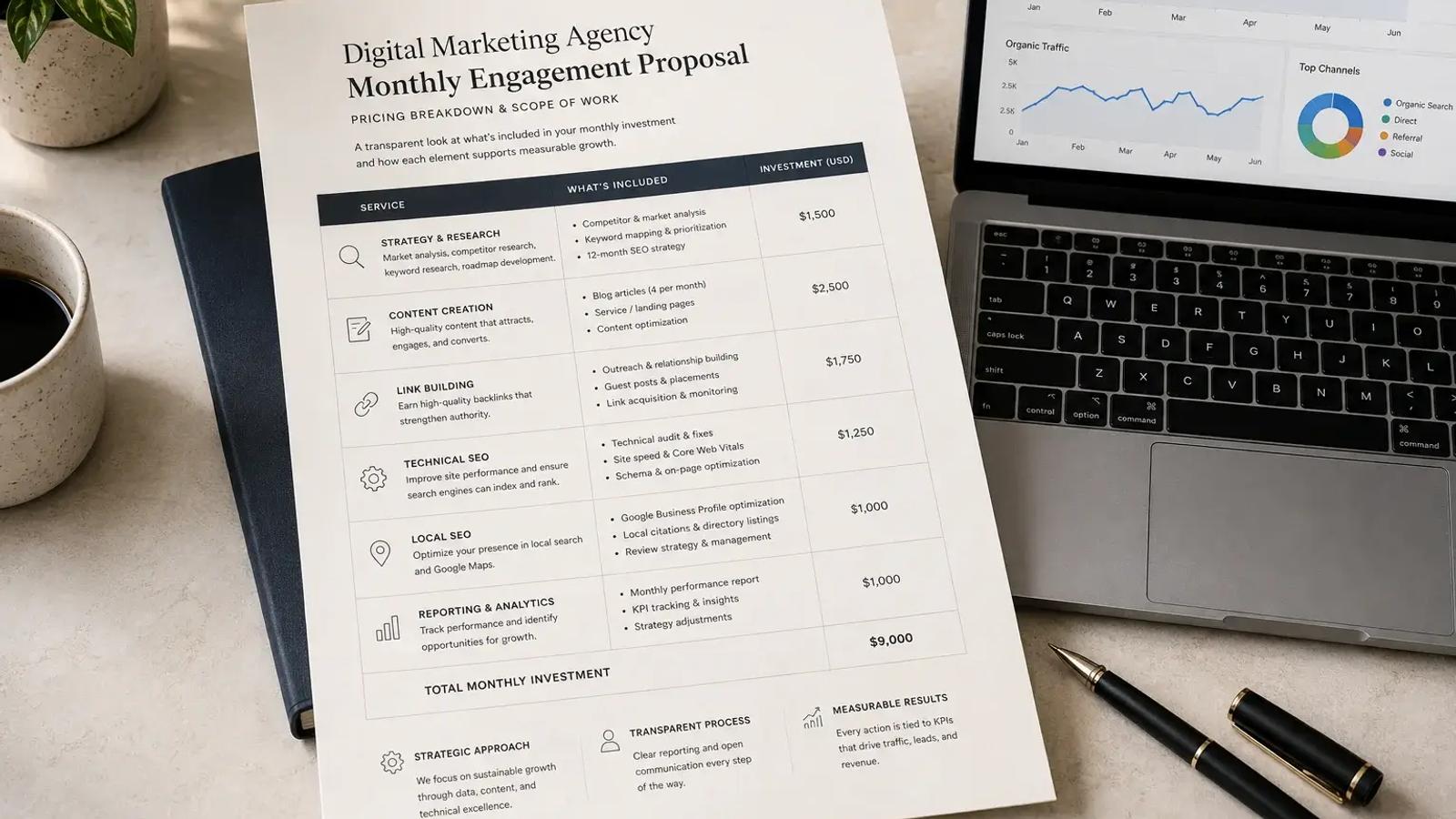
The proposal comes in at $3,500 a month. You've also got one at $900 and another at $6,500. All three call themselves digital marketing agencies. None of the proposals make it obvious what you're actually getting for the difference.
This is the standard experience of shopping for a digital marketing agency in 2026, and the confusion is mostly by design.
Agencies use the same terminology to describe very different scopes. "Full-service digital marketing" can mean a junior contractor running your Instagram or a senior team running paid search, SEO, email, and conversion work under one strategy.
Digital marketing agency pricing in 2026 runs from around $1,000 a month at the entry end to $10,000 or more for full multi-channel retainers. Here's what the market actually looks like, what you're buying at each tier, and how to read a proposal before you sign it.
How Digital Marketing Agency Pricing Is Structured
Before comparing numbers, it helps to understand how agencies charge. In 2026, four pricing models dominate the market, and the one your agency uses affects your risk more than the headline number does.
Flat monthly retainer. The most common structure for ongoing work. You pay a fixed fee each month regardless of hours or output variation.
Per a 2026 Ahrefs survey of 439 SEO providers, 78.2% use a monthly retainer as their primary model. The appeal is predictability: you know the monthly cost, and the agency knows what they're delivering.
Percentage of ad spend. Common for paid media-heavy accounts. The agency charges 10 to 20% of your monthly ad budget, usually with a minimum of $1,000 to $2,500 a month. The risk is misaligned incentives: a percentage model rewards the agency for growing your spend, not for improving your return on it.
Hourly billing. Rates run $75 to $300+ per hour depending on seniority and specialization. Most common for audits and one-off projects, not ongoing relationships.
According to Clutch's 2026 pricing guide, which pulls from over 106,000 agency profiles, the most common hourly band for specialized digital marketing work is $100 to $149 per hour. For SEO-specific pricing, the breakdown of how much SEO costs covers what each tier buys in that channel specifically.
Performance-based or hybrid. A base retainer plus a bonus tied to leads, revenue, or return on ad spend. Growing in popularity, particularly for lead generation and paid media work. About 14% of agency service lines now operate on fully value-based pricing, up significantly from 2024, per Revenue Memo's 2026 agency pricing analysis.
One rule applies across all models: ad spend is always separate from the management fee. A $4,000-a-month agency retainer requiring $10,000 a month in ad budget is a $14,000-a-month commitment. Any proposal that blends management fees and media spend into one number without separating them clearly is worth pushing back on.
Digital Marketing Agency Pricing Tiers in 2026
The market clusters into three practical tiers for service businesses. Here's what you should realistically expect inside each one.
Entry tier: $1,000 to $2,500/month
At this price point, you're typically buying one primary channel done consistently, not a coordinated multi-channel strategy. A realistic entry-tier package might cover local SEO and Google Business Profile (GBP) management, or a single paid platform like Google Ads or Meta. Not both, and rarely with senior oversight.
Execution at this level often involves junior staff, offshore teams, or increasingly AI-generated output with minimal strategic review. The work can be legitimate for a simple scope in a low-competition market. A solo vet clinic in a small city with no meaningful local rivals may do fine here.
For most service businesses competing in a real market, the ceiling on what this tier can accomplish is low. There's simply not enough budget for the strategy, content, and optimization work that moves rankings or fills appointment books at volume.
Mid-tier: $2,500 to $5,000/month
This is where genuine multi-channel work starts. A well-structured mid-tier retainer for a service business might cover SEO plus content (four to eight articles a month), GBP management, one or two paid platforms, and monthly reporting with a real strategy conversation.
Most sources converge on this as the right digital marketing agency pricing band for a single-location service business wanting integrated organic and paid coverage. WebFX lists entry retainers starting around $3,000 a month. Mid-tier boutiques and regional agencies typically start in the $2,500 to $3,500 range.
At the higher end of this tier, you should expect a dedicated account manager, custom strategy (not a templated playbook), and reporting that ties activity to business outcomes like calls, bookings, and form fills rather than just rankings and impressions.
Premium tier: $5,000 to $10,000+/month
Full-service at this level means a team that functions like an embedded marketing department. Paid search, paid social, SEO, content, email, conversion rate work, and sometimes brand strategy all run under one coordinated plan.
Directive publishes a Startup Package at $6,500 a month with no annual contract. Clutch's 2026 marketplace data shows typical projects in the $10,000 to $49,999 range for full-scope digital marketing engagements.
At $10,000 a month and above, agencies are usually delivering 80 to 100 hours of senior work, not junior execution.
Most single-location service businesses don't need this tier. It's built for multi-location groups, brands competing nationally, or businesses at a stage where a fractional CMO and full execution team make economic sense.
What's Actually Included (and What Isn't)
Two proposals can quote the same monthly fee and include completely different scopes. These are the components worth verifying line by line.
Content production. Ask specifically: how many pieces per month, what type (blog posts, service pages, landing pages), and who writes them. Agencies often charge $150 to $300 per blog post when billed separately. An agency promising 15 posts a month inside a $1,500 retainer is doing math that doesn't work, or the quality reflects it.
Google Business Profile management. For local service businesses, this is often the highest-ROI component of the retainer.
Good GBP management means weekly posts, photo updates, Q&A monitoring, active review responses, and tracking calls and direction requests. Ask specifically what's included, "GBP management" means different things at different agencies.
Paid media management. Clarify whether this means campaign setup only, ongoing optimization, or both.
Weekly bid adjustments, ad creative testing, negative keyword management, and conversion tracking are all distinct tasks. A package that includes "Google Ads management" with no cadence around optimization is closer to babysitting an account than running one.
Reporting. A monthly PDF with impressions and clicks is not the same as a reporting call where someone explains why performance moved and what the next 30 days look like.
Per AgencyAnalytics' 2026 benchmark report, surveying 494 agency professionals, 35% of clients prefer results delivered in a one-on-one call. That level of attention is a mid-to-upper tier deliverable, not entry-level.
Ad spend. Always separate. Always. If a proposal doesn't make this explicit, ask before signing anything.
Agency Pricing by Vertical
Pricing tracks the competitiveness of your category and the value of each client. Here's how the market shakes out across the verticals where service businesses tend to spend.
Law firms. One of the most competitive and highest-CPC verticals in local search. Management fees typically run $1,500 to $5,000 a month, separate from ad spend that can reach $5,000 to $50,000 a month for competitive practice areas. Combined SEO and paid retainers in major metros commonly land between $3,000 and $9,500 a month.
Med spas. Full-service retainers for a single-location practice typically run $2,500 to $6,000 a month in management fees, with ad spend of $1,500 to $3,000 a month on top. Specialist platforms like PatientGain list starting prices of $1,699 to $2,499 a month for tech-plus-service bundles specific to aesthetics.
HVAC and home services. Mid-market contractors typically spend $1,000 to $8,000 a month on digital marketing management, with $5,000 a month cited as a common sweet spot for a $1 million to $3 million shop. Top operators often reinvest 7 to 12% of revenue into marketing.
Veterinary clinics. Single-location practices commonly spend $1,000 to $3,000 a month in management fees, with practices generally allocating 2 to 5% of gross revenue to marketing overall. Competition-level, not practice size, is the primary driver of where in that range you land.
The Pricing Red Flags Worth Knowing
A proposal that looks competitive on price often has gaps that cost more in wasted budget than a higher retainer would have.
You don't own the accounts. Some agencies set up Google Ads and Meta accounts in their own name, retaining control of your data and historical performance if you leave. Your website, ad accounts, analytics, pixels, content, and campaign history should be in your name from day one. If a contract doesn't say this explicitly, ask.
Deliverables are described by category, not by output. "SEO," "content marketing," and "paid media management" are not deliverables. They're categories.
A solid proposal tells you how many pieces of content ship each month, which pages get optimized, what GBP management includes week to week, and what reporting looks like. The breakdown of SEO packages for small businesses is a practical reference for what itemized scope looks like.
Long lock-ins with no exit terms. A 12-month contract isn't inherently wrong. Signing one before you've seen the deliverables and understood the exit terms is a risk. Month-to-month options exist at every price point in the market. Agencies with good retention rates don't need punitive exit clauses to keep clients.
Reporting that stays in the agency's tools. If you can't see live performance data and must wait for a monthly PDF to understand what's happening, that's a transparency problem. Most serious agencies give clients direct dashboard access to their own accounts.
Pricing dramatically below market. A $500-a-month "full-service" proposal isn't a good deal. It signals that execution is offshored, AI-generated without strategic review, or so thin it won't move anything.
The economics of producing real work don't support it. A $1,000 to $1,500 a month floor is the minimum for legitimate ongoing service in most markets.
How to Evaluate a Proposal Before You Sign
Run every proposal through these five questions before committing to anything.
What exactly ships each month? Ask for a numbered deliverable list for month one. Specific tasks, specific outputs, named platforms. If the agency can't answer this clearly before you sign, they won't answer it clearly after either.
Who does the work? The person pitching you and the person managing your account are often different people. Ask specifically who your day-to-day contact is and what their background is. Senior strategist or junior account coordinator makes a real difference at the $2,500 to $4,000 tier.
How is ad spend separated? Get the all-in monthly number in writing: management fee, setup fees, tool costs, and media budget all listed separately. Then evaluate the management fee against the scope, not the total.
How is success measured? Rankings, impressions, and clicks are inputs. Booked appointments, qualified leads, and cost per acquisition are outputs. Ask which numbers the agency tracks and reports on, and confirm those are the ones that connect to your actual business goals.
What happens when you leave? Account ownership, content rights, data portability, and exit notice requirements should all be in the contract. A clean handoff clause is a mark of an agency that earns retention rather than contracts it.
Where Lunova Fits in the Market
Lunova Growth Marketing Agency is a boutique full-service agency built specifically for service businesses: med spas, law firms, vet clinics, wellness studios, groomers, HVAC contractors, and local service businesses.
One retainer covers paid ads, SEO, social, email, CRO, and GBP management. One account manager, not a rotating team. Ad spend is always separate from the management fee.
We start at $2,200 a month on a month-to-month basis with no lock-in. We also build custom scopes for businesses that don't need the full stack: local SEO and paid only, organic SEO and content only, or any combination that matches where the business is right now. The Growth Audit shapes the scope recommendation before we talk pricing.
That positions us inside the mid-tier of the market on price, with a scope that competes at the upper end. The full package breakdown is on our packages page. Reach out to Lunova today, and our free Growth Audit will show you what the right scope looks like for your business and your market specifically, before you commit to anything.
Price Tells You the Tier, Not the Value
Digital marketing agency pricing in 2026 ranges from $1,000 a month for single-channel entry work to $10,000 or more for full-service retainers. The number matters, but the scope behind it matters more.
A $3,500 proposal with four named deliverables, a clear reporting cadence, and month-to-month terms is a different product from a $3,500 proposal for undefined "digital marketing services" on a 12-month contract. They're quoted the same. They don't produce the same results, and they carry very different risk.
Ask what ships, ask who does it, ask how you'll know if it's working, and ask what happens if it's not. Reach out to Lunova today, our free Growth Audit will give you a clear picture of what your business needs and what that should cost before you compare another proposal.
Frequently Asked Questions
How much does a digital marketing agency cost per month?
Digital marketing agency costs per month typically range from $1,000 to $2,500 for entry-level single-channel work, $2,500 to $5,000 for genuine multi-channel retainers covering SEO, paid, and content, and $5,000 to $10,000+ for complete full-service engagements with senior oversight across all channels.
These figures cover management fees only. Ad spend is always additional, and at competitive price points can easily double or triple the total monthly investment.
What is included in a digital marketing agency retainer?
What a digital marketing agency retainer includes varies significantly by tier and agency.
At the mid-tier ($2,500 to $5,000/month), a real retainer should cover two to three integrated channels, a named account manager, a custom strategy built around your business, regular content production, and monthly reporting tied to business outcomes like calls and bookings.
At the entry tier, expect one primary channel with junior or outsourced execution. At the premium tier, expect a team functioning as an embedded marketing department across all channels. Always ask for a specific, numbered deliverable list before signing.
What is the difference between agency fees and ad spend?
The difference between agency fees and ad spend is fundamental and often misunderstood. Agency fees cover strategy, management, content production, reporting, and account oversight. Ad spend is the separate budget paid directly to platforms like Google, Meta, or LinkedIn to run ads.
A $4,000-a-month management fee requiring $8,000 a month in ad budget is a $12,000-a-month total commitment. Any proposal that blends these two figures without clearly separating them is worth pushing back on before you sign.
How do digital marketing agencies charge for their services?
Digital marketing agencies charge for their services using four main models: flat monthly retainers, percentage of ad spend, hourly billing, and performance-based or hybrid arrangements.
Flat retainers are the most common, used by 78.2% of SEO providers per Ahrefs' 2026 survey. Percentage-of-spend runs 10 to 20% with a monthly minimum. Hourly billing ($75 to $300+ per hour for audits and one-off work), and performance-based or hybrid arrangements tying part of the fee to outcomes.
For ongoing multi-channel work, flat retainers provide the most predictability for both parties. Percentage-of-spend models are common for paid media-heavy accounts but can create incentives to grow budget over improving return.
How long does it take for digital marketing to show results?
How long digital marketing takes to show results depends on the channel. Paid advertising can generate leads in days once campaigns are live and dialed in. SEO typically takes three to six months before meaningful ranking movement, and six to twelve months before it compounds into a consistent lead source.
For most service businesses, a well-run combined paid and organic strategy starts producing measurable results within 60 to 90 days on the paid side, while organic builds over the following two to three quarters.
Is hiring a digital marketing agency worth it?
Hiring a digital marketing agency is worth it for a small service business when two conditions are met: the scope matches the market, and the deliverables are specific enough to hold someone accountable to.
A well-run agency at the right price point will outperform a business owner trying to manage paid ads, SEO, content, and GBP simultaneously while running operations.
The economics are better, the output is more consistent, and the compounding effect of integrated channels outperforms any single tactic. The mistake is buying a package priced for comfort rather than for the scope the market requires.
What should I ask an agency before signing?
Before signing a contract with a digital marketing agency, ask for: a numbered deliverable list for the first month, confirmation of who does the work, a clear breakdown of management fees versus ad spend, how success is measured, and what the exit terms are including data and account ownership upon departure.
Agencies with strong track records welcome these questions. Agencies that deflect them or respond with vague reassurances are telling you something about how they operate.