
Everyone's Posting About Jev AI. What's Actually True?
Your feed is full of hot takes on Jev AI. We looked past the hype to see what TypeSafe's new model can actually do for SEO and AI-visibility work.
Your LinkedIn feed has looked a little unhinged this week.
One post claims Jev AI killed seven SEO workflows overnight. Another calls it the wildest thing to happen to SEO all year. A third is a careful eight-slide breakdown of exactly where to trust it and where not to. They're all talking about the same product, and they don't agree on much beyond the name.
We run search visibility for a living, so a model promising AI decisions at a fraction of the usual cost isn't something we scroll past. We looked into what Jev AI actually is, what it's built to do, and where the hype has already gotten ahead of the product.
What Jev AI Actually Is
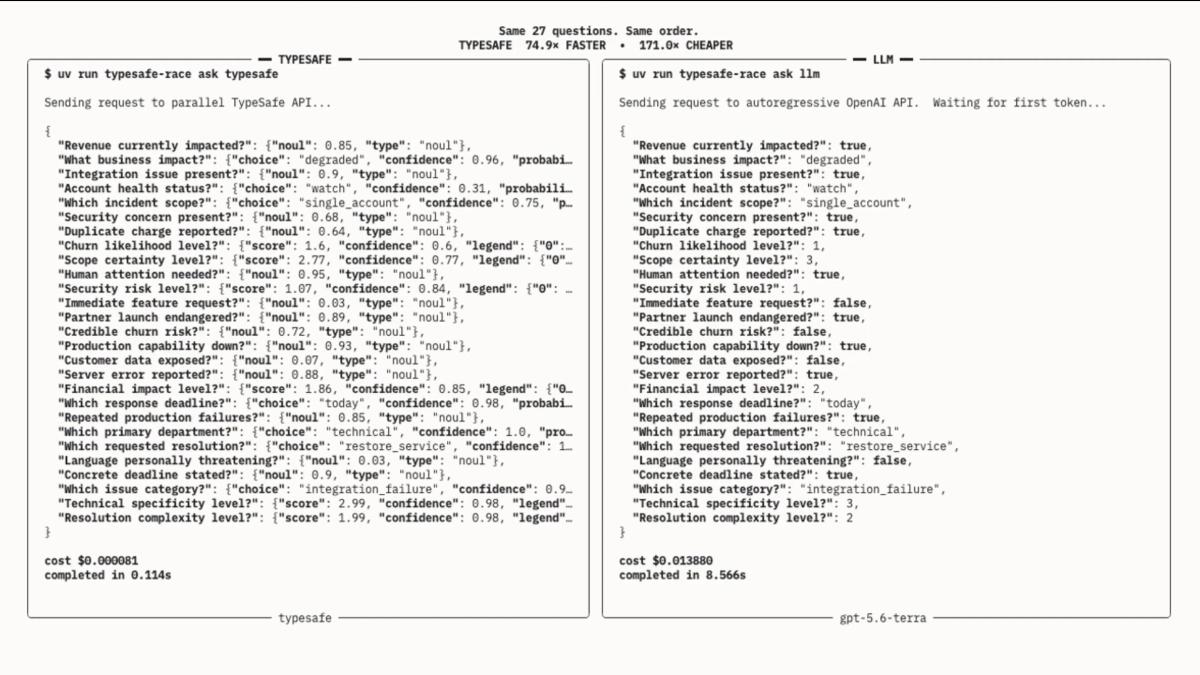
Jev is a new AI model from TypeSafe AI, a San Francisco lab founded by Diogo Almeida. Almeida worked on ChatGPT and helped develop RLHF, the training method behind most modern chatbots, during his time at OpenAI.
TypeSafe came out of stealth on September 15, 2026, with a $40 million seed round attached and Jev as its first public model.
Every large language model you've used so far, GPT, Claude, Gemini, works the same basic way. It writes an answer one word at a time, predicting what comes next based on everything written before it. Jev doesn't do that. TypeSafe calls it a "System One" model, a nod to the fast, automatic thinking Daniel Kahneman wrote about in Thinking, Fast and Slow.
Instead of writing a paragraph, Jev reads a block of information you give it, along with a set of questions you've already defined, and returns a decision. Not prose. A decision, with a confidence score attached.
That's the entire shift. You're not asking Jev to figure out what to say. You're asking it to judge something you've already framed, inside options you already set.
The Three Kinds of Answers Jev Can Give
TypeSafe built Jev around three fixed answer types, called primitives. Every question sent to Jev has to fit one of these shapes.
- Noul. A yes/no probability. "Is this page ready to be cited by an AI answer engine?" returns a confidence score, not an essay.
- Choice. One option picked from a list set in advance. "Is this search commercial, informational, or mixed intent?" returns exactly one of the three.
- Score. A position on a scale you define. "How relevant is this page to the target query, on a scale of 0 to 4?" returns a number.
Because every possible answer is fixed before Jev sees the question, it can't invent a category that wasn't offered or wander into an unrelated paragraph. TypeSafe presents this as eliminating hallucination. That's true in a narrow sense: Jev can't make up an answer that wasn't on the list provided. It can still pick the wrong one that was.
TypeSafe's own documentation is upfront about this. A Noul question where "true" secretly means "no" will produce worse answers, and Jev's known failure mode is a bad or contradictory question, not a model that goes off-script on its own.
The Real Comparison Isn't Jev vs. ChatGPT
Running every page on a site, or every keyword in a Search Console export, through a full chat-style model gets expensive fast. That's a large part of why most SEO audits sample a few hundred items and extrapolate, rather than checking everything.
The pitch behind Jev isn't that it writes better than a chat model. It's that judging 50,000 keywords one at a time stops being a budget problem, so nobody has to guess about the other 49,500.
If that holds up at the price TypeSafe is advertising remains an open question. The underlying logic, judging everything instead of a sample, is worth understanding either way.
One practitioner recently ran internal-link mapping, deciding which of thousands of page pairs on a site actually deserved a link, through Jev alongside a full chat model on the same set of pages. Jev finished first, at a small fraction of the token cost.
That's not an independently verified benchmark, but a fair description of the kind of task Jev is actually built for: a few thousand yes-or-no calls in a trenchcoat, not a writing job.
Why the Cost Numbers Are Getting So Much Attention
Search TypeSafe's name next to Jev and the numbers get big fast: 100 to 200 times faster than a typical language model, 40 to 445 times cheaper, with output tokens priced at free and input running around $0.042 per million tokens.
On paper, that changes the math for anything normally run through a full chat model just to get a one-word answer.
Those figures come from TypeSafe's own technical notes, tested on TypeSafe's own benchmark, scored against labels TypeSafe built by averaging other AI models' outputs.
That doesn't make the numbers false. It does mean nobody outside the company has independently confirmed them yet, and TypeSafe's own notes acknowledge the results likely sit at the high end of what you'd see in practice.
A few of the more careful posts making the rounds this week say the same thing more bluntly: separate model price, decision quality, and total workflow cost before believing a headline number, because a cheap decision that's wrong still costs time to catch.
One widely shared SEO demo explicitly labels itself a simulated run on illustrative data, not a live production result. Worth remembering before anyone rebuilds a workflow around a model that launched a week ago.
What Jev Explicitly Can't Do
TypeSafe's own documentation lists a specific set of things Jev won't do, not because of a temporary limitation, but because of how the model works.
- It can't crawl or search. Jev has no way to fetch a webpage or query Google on its own. Something else has to gather the page content and hand it over first.
- It can't pull data from your tools. Search Console, Ahrefs, PostHog, whatever you use, none of it flows into Jev directly. A separate system has to export it and shape it into the information Jev reads.
- It can't monitor AI platforms. Checking if ChatGPT, Gemini, or an AI Overview mentions your brand still needs its own tracking setup. Jev can judge what a result shows once fed in, not fetch that result itself.
- It can't guarantee a citation or a ranking. A high confidence score from Jev means the model is confident in its answer, not that Google or an AI answer engine will actually surface the page in question.
In practice, that means Jev sits in the middle of a pipeline, not at either end of it. Something has to feed it clean information, and someone, usually a person, still has to decide what to do with a low-confidence answer. We go deeper on where those limits actually bite in a real SEO workflow in a follow-up piece.
Why This Is Showing Up in Marketing Feeds, Not Just Developer Ones
A lot of SEO and AI-visibility work is exactly the kind of repetitive judgment Jev is built for.
Is this search query commercial or informational? Does an existing page already cover the topic well enough, or is there a real gap? Does a competitor's page have proof this one is missing? Those are decisions made hundreds or thousands of times across a site, not paragraphs that need to be written.
That's a real fit, and it's why early testers are already trying Jev against tasks like intent classification, flagging which pages an AI answer engine is likely to cite, and scoring AI-written drafts before a human reviews them.
It's also a narrow fit. Jev can't crawl a website, pull data from Search Console, or write the page itself, so something else still has to gather the information and hand Jev a clean, well-defined decision.
There's a telling data point buried in the search trends around Jev's launch: most of what people are actually typing into Google is developer-flavored, its API, its GitHub repo, its architecture. The SEO conversation happening across LinkedIn right now is running well ahead of that search behavior. That's not a reason to ignore it. It's a reason to treat this as early, not proven.
For most of the service businesses we work with, this kind of AI-visibility question already sits right next to their Google Business Profile optimization and local SEO work, the two levers that decide if they show up at all before a searcher ever reads a word of content.
Jev doesn't change what those levers are. It's a candidate for speeding up how fast someone can judge if they're working. We go deeper on exactly where it fits in an AEO and GEO workflow, and where it doesn't, in the next piece in this series.
If you're marketing an early-stage SaaS product rather than a local service business, we've also put together a closer look at if Jev is worth testing yet.
We're Testing This Before We Trust It
Most new AI tools get judged by their demo, not by the workflow they'd actually sit inside. That gap is exactly how a business ends up rebuilding its search strategy around something nobody's tested past week one.
We're running Jev AI against our own SEO and AI-visibility work before recommending it to anyone else, and we'll publish what actually holds up. If you'd rather have a second opinion on the system currently handling your search visibility right now, our free Growth Audit is a good place to start.
Frequently Asked Questions
What is Jev AI?
Jev AI is a decision-making model from TypeSafe AI that returns structured answers, a yes/no, a chosen option, or a score, instead of writing text. It launched in limited early access on September 15, 2026.
Is Jev AI the same as ChatGPT or Claude?
Jev AI is not the same as ChatGPT or Claude. Those models generate text one word at a time. Jev reads a block of information plus a fixed set of questions and returns the answer that best fits, with no prose involved.
Can Jev AI write blog posts or website content?
Jev AI can't write blog posts or website content. TypeSafe's own documentation says forcing text output out of Jev works badly and slowly, and that isn't the job the model was built for.
Is Jev AI accurate?
Jev's accuracy depends entirely on the questions and options it's given. It can't invent an answer outside the list provided, but it can still choose the wrong one from inside that list, and TypeSafe's own speed and cost figures are self-reported, so treat any specific number as a claim worth checking rather than a settled fact.
Who built Jev AI?
Jev was built by TypeSafe AI, a San Francisco lab founded by Diogo Almeida, who worked on ChatGPT and RLHF at OpenAI before starting the company.
Does Jev AI replace an SEO strategist?
Jev does not replace an SEO strategist. It can classify, score, and flag decisions at a scale no person can match by hand, but someone still has to decide which questions are worth asking and judge if a given answer actually makes sense.