
We Asked 4 AI Platforms to Recommend Local Businesses. Here's What We Found (2026)
We ran 60 queries across ChatGPT, Perplexity, Gemini, and Google AI Overviews covering four service verticals and three cities. Here's what we found.
One question drove this study: does ChatGPT recommend your business when a client searches for what you offer?
We opened ChatGPT, Perplexity, Gemini, and Google AI Overviews. We typed in the questions your potential clients are asking right now: "best med spa in Atlanta," "who should I call for AC repair," "recommend a vet clinic near me." Then we recorded exactly which businesses each platform recommended, and which ones it ignored completely.
Sixty queries. Four platforms. Four service verticals. Three cities. The core question: does ChatGPT recommend your business, or a competitor two blocks away?
That is the question this study was built to answer. Does ChatGPT recommend your business when a client searches for what you offer? The data says: it depends entirely on platform, query, and city.
The same businesses that rank well on Google were sometimes invisible in AI recommendations. Businesses with fewer reviews were sometimes the first name out. And one business that was recommended confidently had been permanently closed for months.
This is the Lunova AI Recommendation Study. Here is what we found, how we ran it, and what it means for any service business trying to stay visible in 2026.
Why We Ran This Study
The conversation around AI search has been dominated by commentary. Everyone has a take on whether AI will replace Google, whether ChatGPT is sending traffic, whether you need to optimize for AI. Very few people have sat down and actually run the queries.
We wanted real data. Not a single query run in one city or a mere thought experiment, but an actual systematic test across the platforms your clients are using, the verticals we serve, and the query formats that reflect how people actually ask for recommendations.
The goal: find out whether ChatGPT and other AI platforms recommend your business, ignore you, or send potential clients to a competitor. The answer depends on which platform, which query, and which city. And that variation is the most important thing this study shows.
Study Methodology
We ran 60 total queries between August and September 2026. Every query was run manually, in real time, with screenshots taken at the moment of output. No API calls, no automated tools.
We wanted the same experience your client has when they open ChatGPT on their phone and type "best HVAC company in Atlanta," or when they ask whether ChatGPT recommends your business over the one down the street.
Platforms Tested
- ChatGPT (browsing enabled): the most widely used AI assistant for direct recommendations.
- Perplexity: citation-heavy AI search that leans on authoritative third-party sources.
- Gemini (standalone app): Google's AI assistant, run independently of Google Search.
- Google AI Overviews: the AI layer that appears inside standard Google search results.
Google AI Overviews are treated separately from the other three throughout this study. ChatGPT, Perplexity, and Gemini are destination products. A person chose to go there instead of Google. An AI Overview appears passively inside a search result. That distinction matters for how we interpret the data.
Verticals and Cities Tested
- Verticals: med spas, HVAC companies, law firms, and veterinary clinics
- Cities: Atlanta, GA (large metro), Chattanooga, TN (mid-size market), Flagstaff, AZ (small market)
Query Types Tested
For each vertical and city combination, we ran five query types:
- Best [vertical] in [city]. The most common discovery query. A cold prospect who has not narrowed down their options.
- Recommend a [vertical] in [city]. A conversational phrasing of the same intent.
- Top-rated [vertical] near [city]. A rating-focused query that signals the person cares about review scores.
- Who should I call for [specific service] in [city]. A service-specific query: Botox instead of med spa, AC repair instead of HVAC, a specific attorney type instead of law firm.
- [Vertical] in [city] that takes walk-ins / does emergency repairs / takes new patients. An availability-focused query with a practical qualifier.
What We Recorded
For each query run, we recorded:
- Which business was named as the primary recommendation
- Which additional businesses appeared in the shortlist
- Whether star ratings and review counts were shown
- Whether sources or citations were visible
- Whether a Google AI Overview appeared at all for that query
We did not combine results across platforms into a single ranking. Each platform's outputs are reported separately, because the findings only make sense when you can see which platform said what.
Finding 1: Four Platforms, Four Different Answers to the Same Question
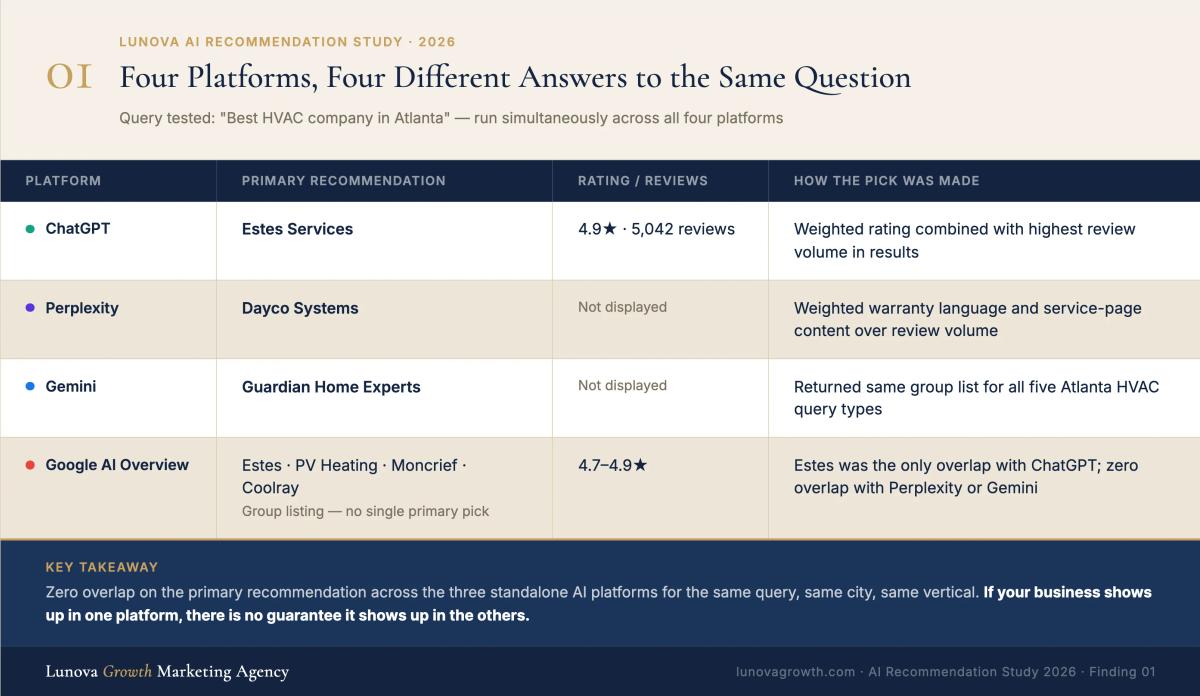
The most striking finding in the study: for the same query in the same city, the four platforms often named four completely different businesses as their primary recommendation.
We tested "best HVAC company in Atlanta" across all four platforms simultaneously. Here is what each one said:
- ChatGPT: Estes Services (4.9 stars, 5,042 reviews): named as primary pick based on rating and review volume
- Perplexity: Dayco Systems: weighted warranty language and service-page content differently
- Gemini: Guardian Home Experts: named across all five Atlanta HVAC query types identically
- Google AI Overview: Estes Services, PV Heating, Moncrief, and Coolray as a group; no single primary pick; Estes was the only overlap with ChatGPT
Zero overlap on the primary recommendation across the three standalone AI platforms. Estes appeared in both ChatGPT and the AI Overview, but Perplexity and Gemini did not name it at all.
This pattern repeated across every vertical and city we tested. For "best law firm in Atlanta":
- ChatGPT declined to name a single best firm and split its answer by practice area, naming Kilpatrick for corporate and Holston & Huntley for personal injury
- Perplexity named Alston & Bird for corporate matters and split by practice area; but for the "who should I call" query, it redirected to the Atlanta Bar Association's referral service without naming any firm
- Gemini named King & Spalding, Alston & Bird, and Kilpatrick as a group list across all query types
- Google AI Overview named Alston & Bird and Jones Day
Four platforms, four fundamentally different approaches, zero coordination. If your business shows up in one of them, there is no guarantee it shows up in the others.
Finding 2: How You Word the Query Changes Who Gets Recommended
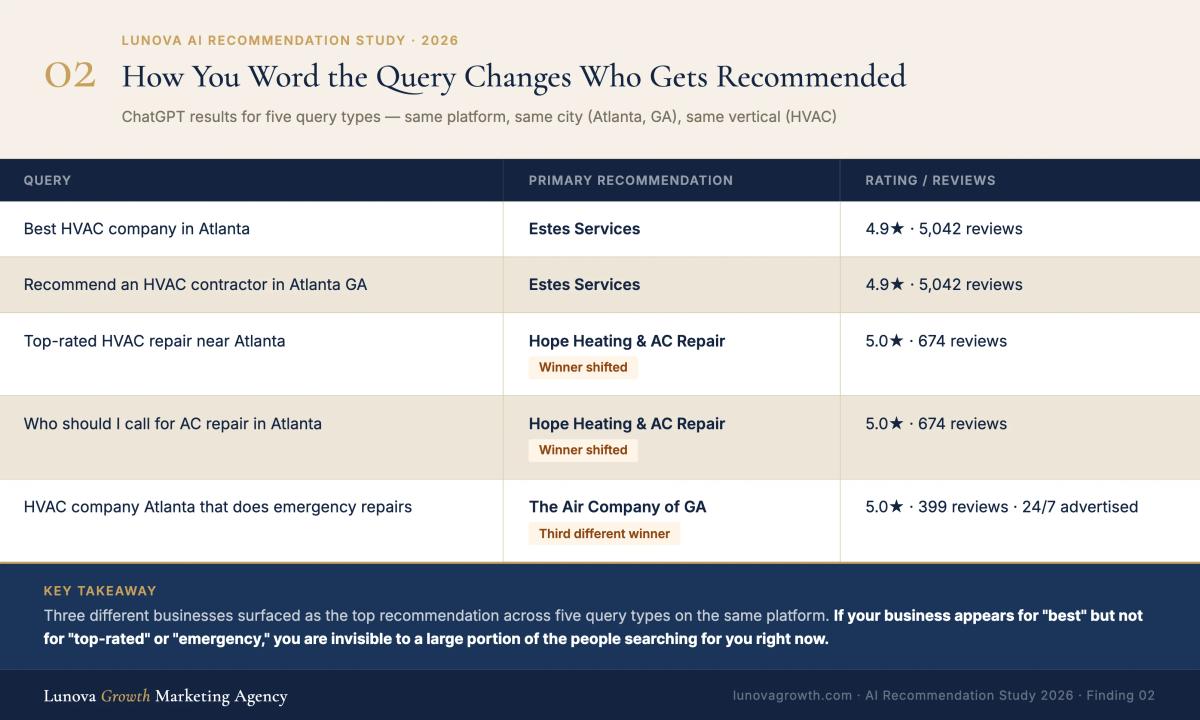
Across all four verticals and all three cities, the phrasing of the query changed the primary recommendation in nearly every case. Same platform, same city, same vertical: different wording, different winner.
Here is what ChatGPT returned for five different Atlanta HVAC query types:
- Best HVAC company in Atlanta: Estes Services (4.9★ · 5,042 reviews)
- Recommend an HVAC contractor in Atlanta GA: Estes Services (4.9★ · 5,042 reviews)
- Top-rated HVAC repair near Atlanta: Hope Heating & AC Repair (5.0★ · 674 reviews); winner shifted
- Who should I call for AC repair in Atlanta: Hope Heating & AC Repair (5.0★ · 674 reviews); winner shifted
- HVAC company Atlanta that does emergency repairs: The Air Company of GA (5.0★ · 399 reviews · 24/7 advertised); third different winner
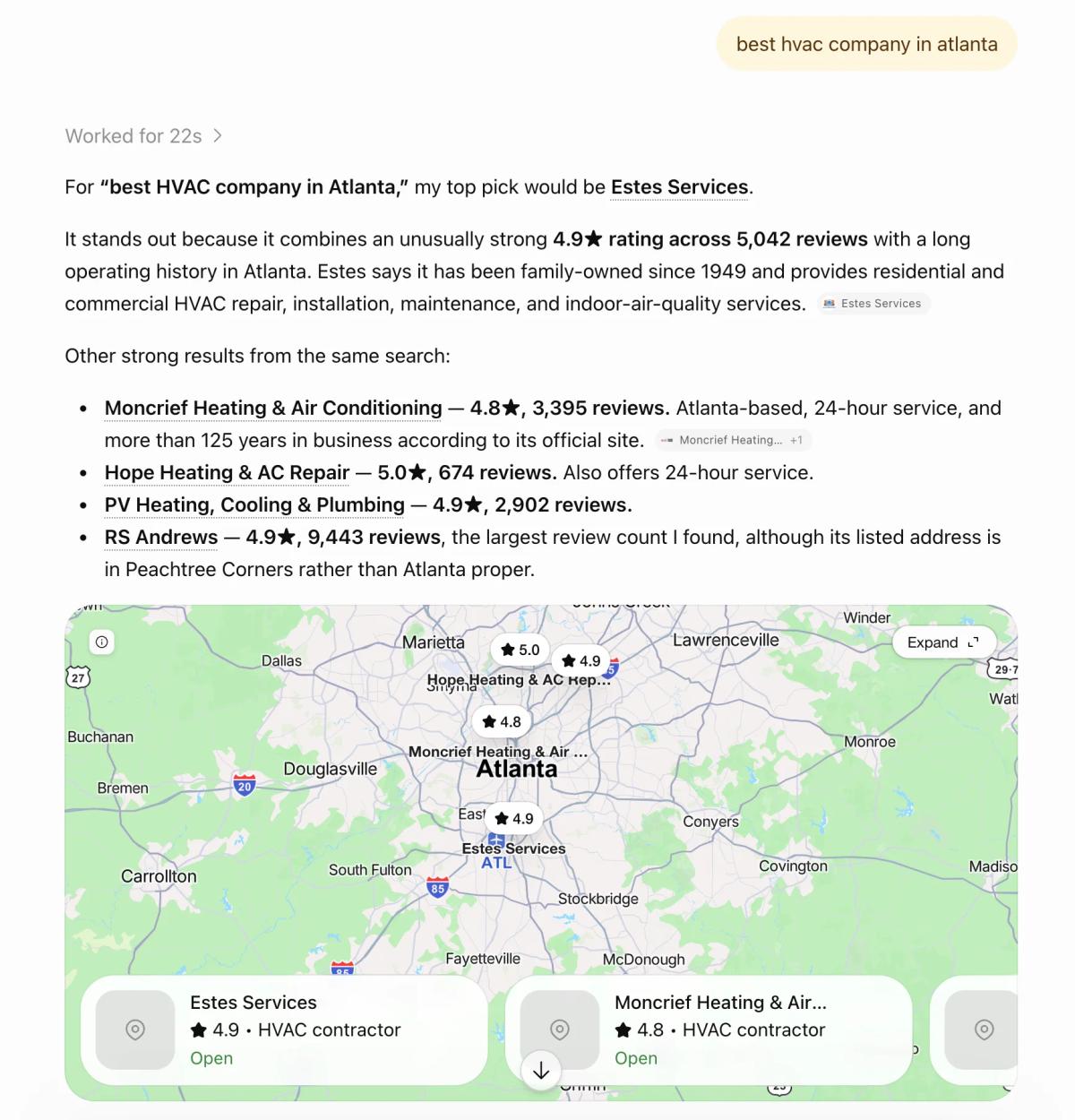
Three different businesses across five query types, for the same city, same vertical, same platform. In Chattanooga, ChatGPT named four different companies across five HVAC queries. In Flagstaff, Confident Comfort Heating & Cooling won four of five query types, the only company in the study to show that level of consistency on a single platform.
If your business is optimized to appear for "best [vertical] in [city]" but not for "top-rated" or "emergency" variants, you may be invisible to a large portion of the people asking about your vertical right now.
Finding 3: "Top-Rated" Queries Consistently Produce Different Winners
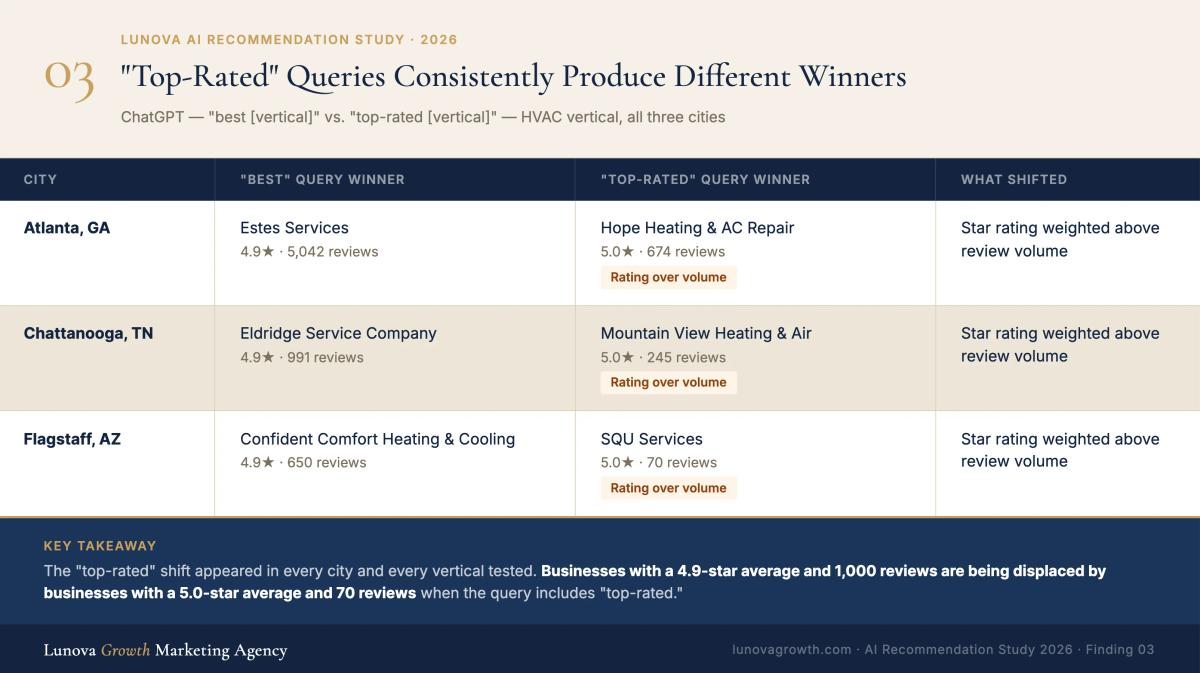
Across every city we tested, adding "top-rated" to a query shifted the AI's recommendation to a smaller business with a perfect 5.0-star rating, away from the larger business with a 4.9 rating and far more reviews. This happened in every vertical and every city.
ChatGPT results for "best" versus "top-rated" HVAC queries:
- Atlanta, GA: Estes Services (4.9★ · 5,042 reviews) won "best"; Hope Heating & AC Repair (5.0★ · 674 reviews) won "top-rated"
- Chattanooga, TN: Eldridge Service Company (4.9★ · 991 reviews) won "best"; Mountain View Heating & Air (5.0★ · 245 reviews) won "top-rated"
- Flagstaff, AZ: Confident Comfort Heating & Cooling (4.9★ · 650 reviews) won "best"; SQU Services (5.0★ · 70 reviews) won "top-rated"
The same pattern appeared in the med spa vertical. ELLEMES Medical Spa dominated Atlanta's general queries across platforms. Smaller 5.0-star clinics with fewer than 200 reviews appeared when the query explicitly asked for "top-rated."
A business with a 4.9-star average from 1,000 reviews is not the same as a 5.0-star average from 50 reviews in terms of established reputation. But AI platforms, at least in this study, appear to treat "top-rated" as a signal to weight star rating more heavily than review volume. For service businesses sitting at 4.9 stars with a large review base, this is worth knowing.
Finding 4: Walk-In and Emergency Queries Surface Completely Different Businesses
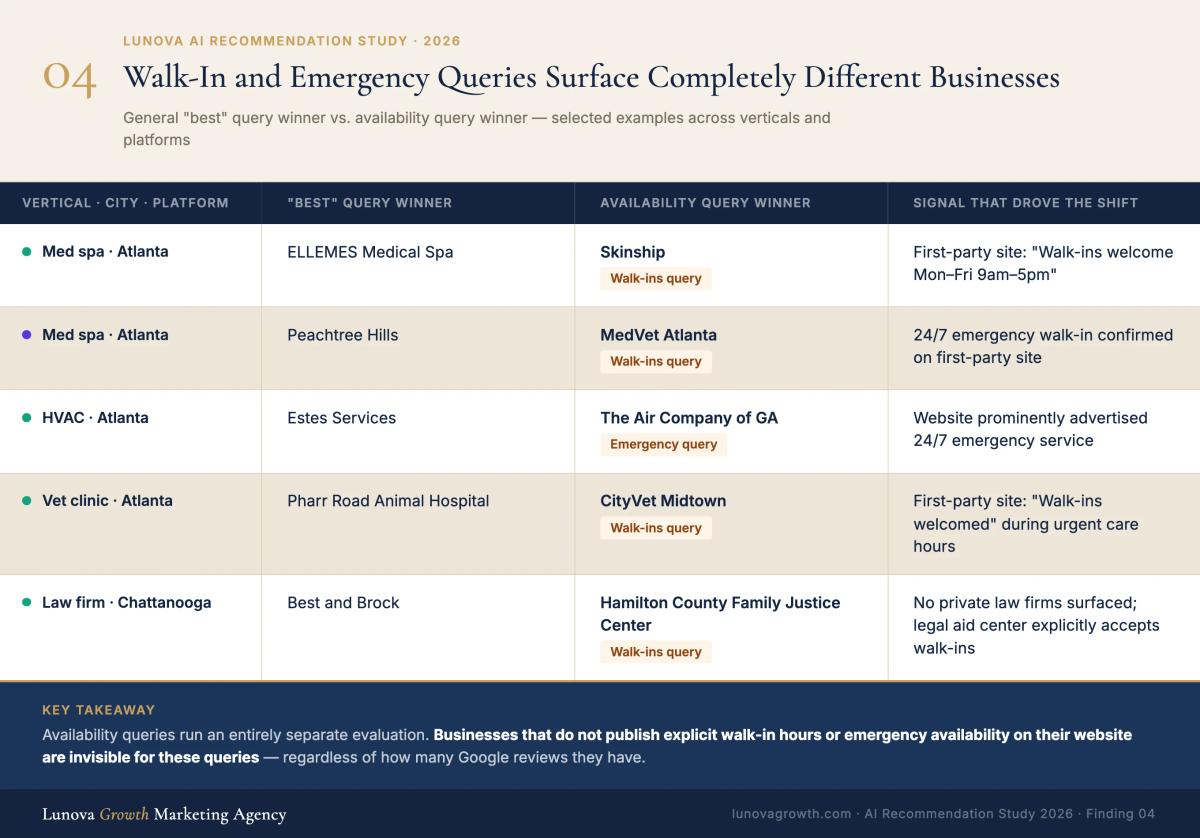
When we added availability qualifiers: "takes walk-ins," "does emergency repairs," "takes new patients." The recommendations changed almost entirely. The businesses that dominated the "best" and "recommend" queries almost never appeared as the primary recommendation for availability-focused queries.
Examples from across the study:
- Med spa, Atlanta (ChatGPT): ELLEMES Medical Spa won "best"; Skinship won walk-ins, citing first-party language: "Walk-ins welcome Mon-Fri 9am-5pm"
- Med spa, Atlanta (Perplexity): Peachtree Hills won general queries; MedVet Atlanta won walk-ins as a 24/7 emergency option
- HVAC, Atlanta (ChatGPT): Estes Services won "best"; The Air Company of GA won emergency queries because its website prominently advertised 24/7 emergency service
- Vet clinic, Atlanta (ChatGPT): Pharr Road Animal Hospital won "best"; CityVet Midtown won walk-ins, citing "Walk-ins welcomed" during urgent care hours
- Law firm, Chattanooga (ChatGPT): Best and Brock won general queries; Hamilton County Family Justice Center won walk-ins; no private law firms were surfaced
AI platforms appear to conduct a separate evaluation for availability queries, looking specifically for first-party language that confirms the qualifier. Businesses that do not publish explicit walk-in or emergency availability on their website are effectively invisible for these queries, regardless of how strong their general reputation is.
Finding 5: Perplexity Applied a Different Standard Depending on Query Type
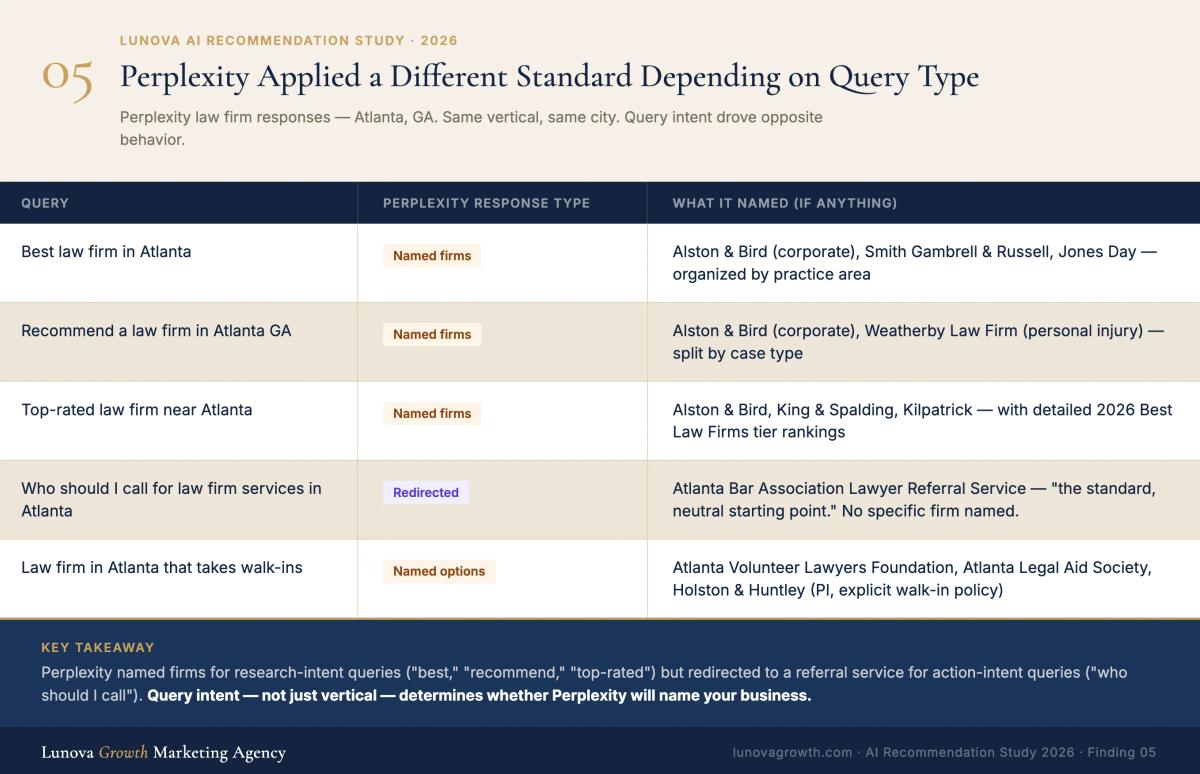
Perplexity's behavior across the law firm vertical stood out enough to be a finding on its own, not because it always refused to name firms, but because the query type changed its behavior more dramatically than any other platform we tested.
For general Atlanta law firm queries, Perplexity named specific firms by practice area:
- "Best law firm in Atlanta": Named Alston & Bird, Smith Gambrell & Russell, and Jones Day as top-tier options, organized by practice area
- "Recommend a law firm in Atlanta GA": Named Alston & Bird for corporate matters and Weatherby Law Firm for personal injury
- "Top-rated law firm near Atlanta": Named Alston & Bird, King & Spalding, and Kilpatrick with detailed tier rankings
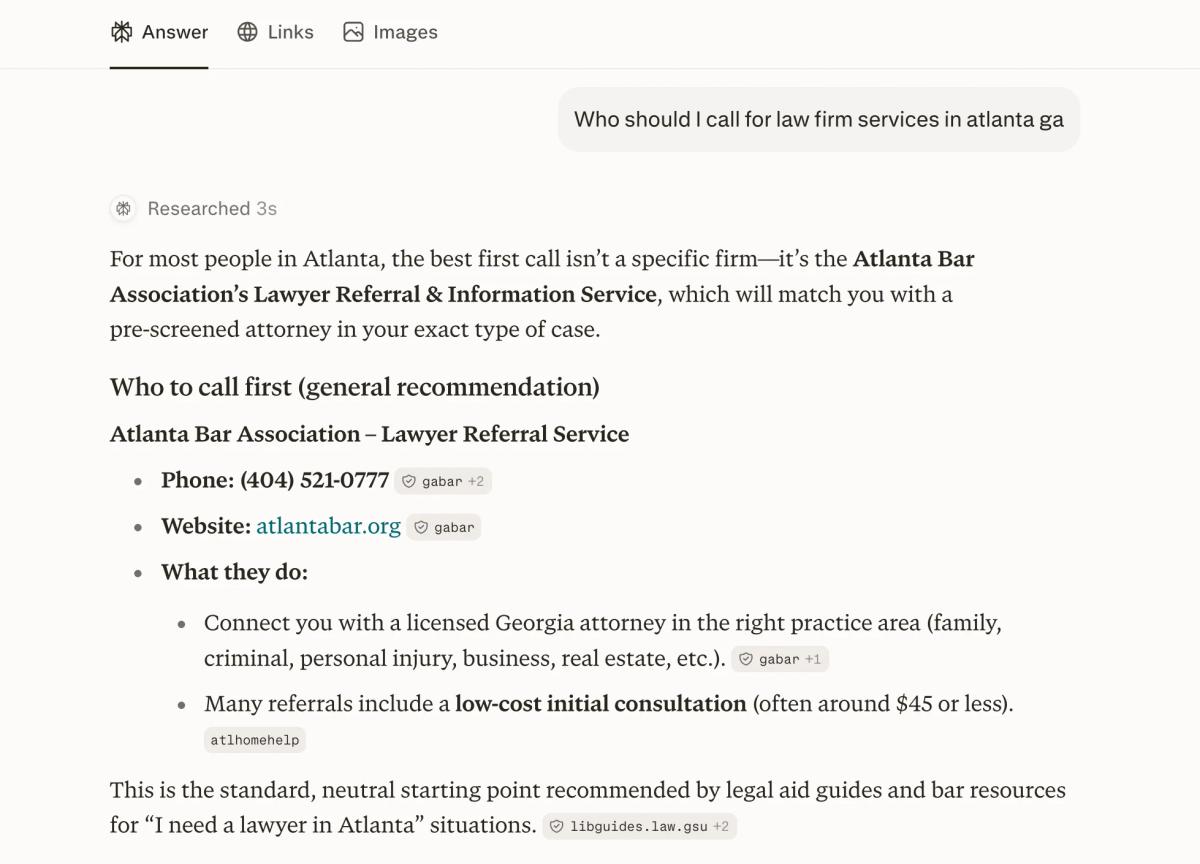
But for the more action-oriented query "who should I call for law firm services in Atlanta," Perplexity shifted entirely, redirecting to the Atlanta Bar Association's Lawyer Referral & Information Service and calling it "the standard, neutral starting point," without naming a single specific firm.
Perplexity also declined to name a top-rated vet clinic in Flagstaff, stating it could not "reliably identify a single top-rated Flagstaff clinic from the available current results."
How Perplexity responded by query type and city:
- Law firm, Atlanta (best/recommend/top-rated): Named specific firms split by practice area: did not give a single overall pick
- Law firm, Atlanta (who should I call): Redirected to Atlanta Bar Association: no specific firm named
- Law firm, Chattanooga: Named Chambliss, Bahner & Stophel: Tier 1 in 19 practice areas, 2026 Best Law Firms
- Law firm, Flagstaff: Named Griffen & Stevens: the only Flagstaff firm with a 2026 Best Law Firms regional award
- Vet clinic, Flagstaff (top-rated query): Declined to name a single top-rated clinic: "cannot reliably identify a single top-rated Flagstaff clinic"
- Med spa, Atlanta (walk-ins): Named MedVet Atlanta: 24/7 emergency walk-in confirmed on first-party site
This pattern suggests Perplexity applies a higher caution threshold when a query implies personal action ("who should I call") versus when it implies research ("what are the best options"). For service businesses, this means Perplexity's behavior cannot be predicted by query topic alone. The intent signal in the query wording matters as much as the vertical.
Finding 6: Gemini Showed Almost No Variance Across General Query Types
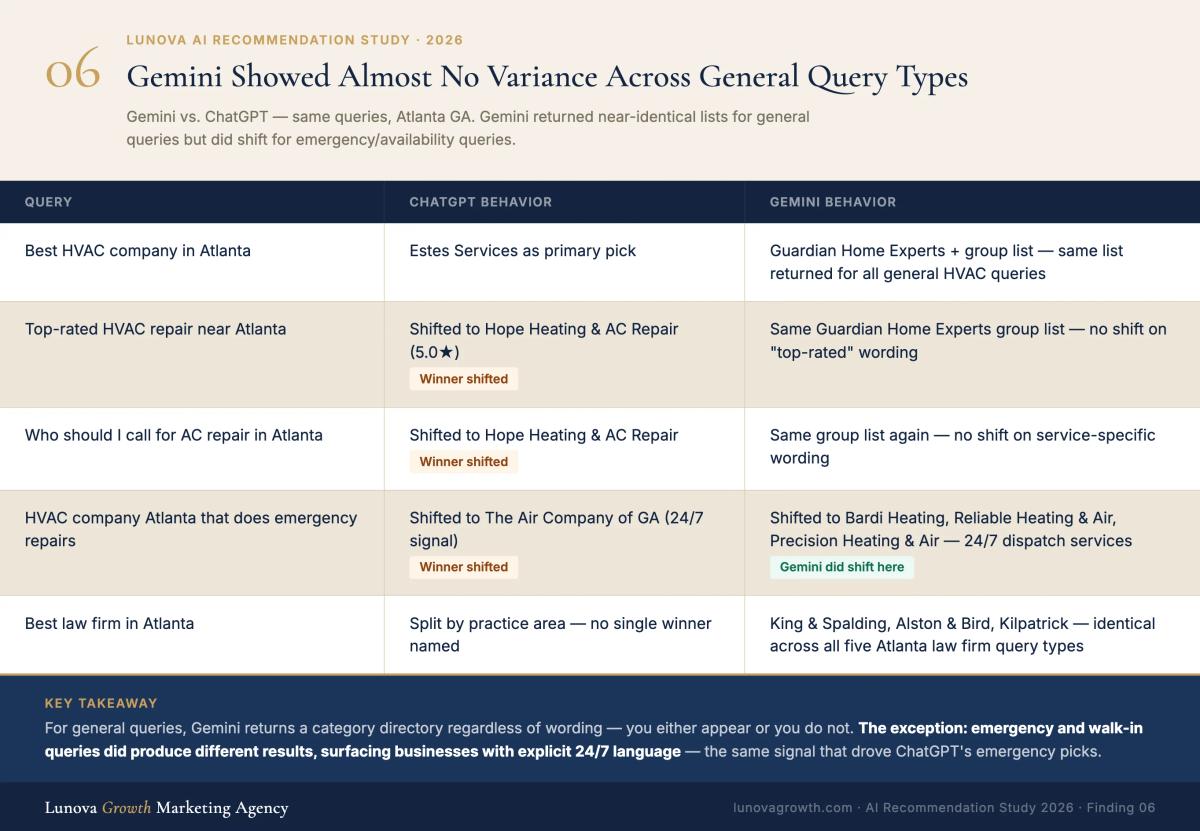
Gemini's behavior was the most consistent of any platform we tested for general queries, but consistent in a way that should concern any business hoping to differentiate itself based on query intent.
For general "best," "recommend," and "top-rated" query types across the HVAC, med spa, and law firm verticals, Gemini produced nearly identical structured lists. The same four or five businesses appeared in the same category buckets regardless of query wording.
How Gemini compared to ChatGPT for general queries:
- "Best HVAC company in Atlanta": ChatGPT named Estes Services as primary. Gemini returned Guardian Home Experts plus a group list; the same list returned for all general Atlanta HVAC queries.
- "Top-rated HVAC repair near Atlanta": ChatGPT shifted to Hope Heating & AC Repair (5.0★). Gemini returned the same Guardian Home Experts group list with no shift.
- "Who should I call for AC repair in Atlanta": ChatGPT shifted to Hope Heating & AC Repair. Gemini returned the same group list again.
- "Best law firm in Atlanta": ChatGPT split by practice area. Gemini named King & Spalding, Alston & Bird, and Kilpatrick: identical across all general law firm query types.
The exception was emergency and walk-in queries. When we ran "HVAC company Atlanta that does emergency repairs," Gemini did shift, surfacing 24/7 dispatch services (Bardi Heating, Reliable Heating & Air, Precision Heating & Air) rather than returning its standard general list. The same pattern appeared in Chattanooga and Flagstaff.
So Gemini's low variance applies to general query types, but availability-specific queries (emergency repairs, walk-ins) did produce different results. For those queries, Gemini appeared to prioritize businesses with explicit 24/7 or emergency language, similar to ChatGPT's behavior.
For businesses trying to understand which query types they show up for, the practical takeaway is this: if you appear in Gemini's list for general "best" or "recommend" queries, that same list likely appears regardless of how the user phrases the general question. But if you want to appear for emergency or walk-in queries on Gemini, that is a separate signal requiring first-party availability language on your website.
Finding 7: Google AI Overviews Appeared Selectively
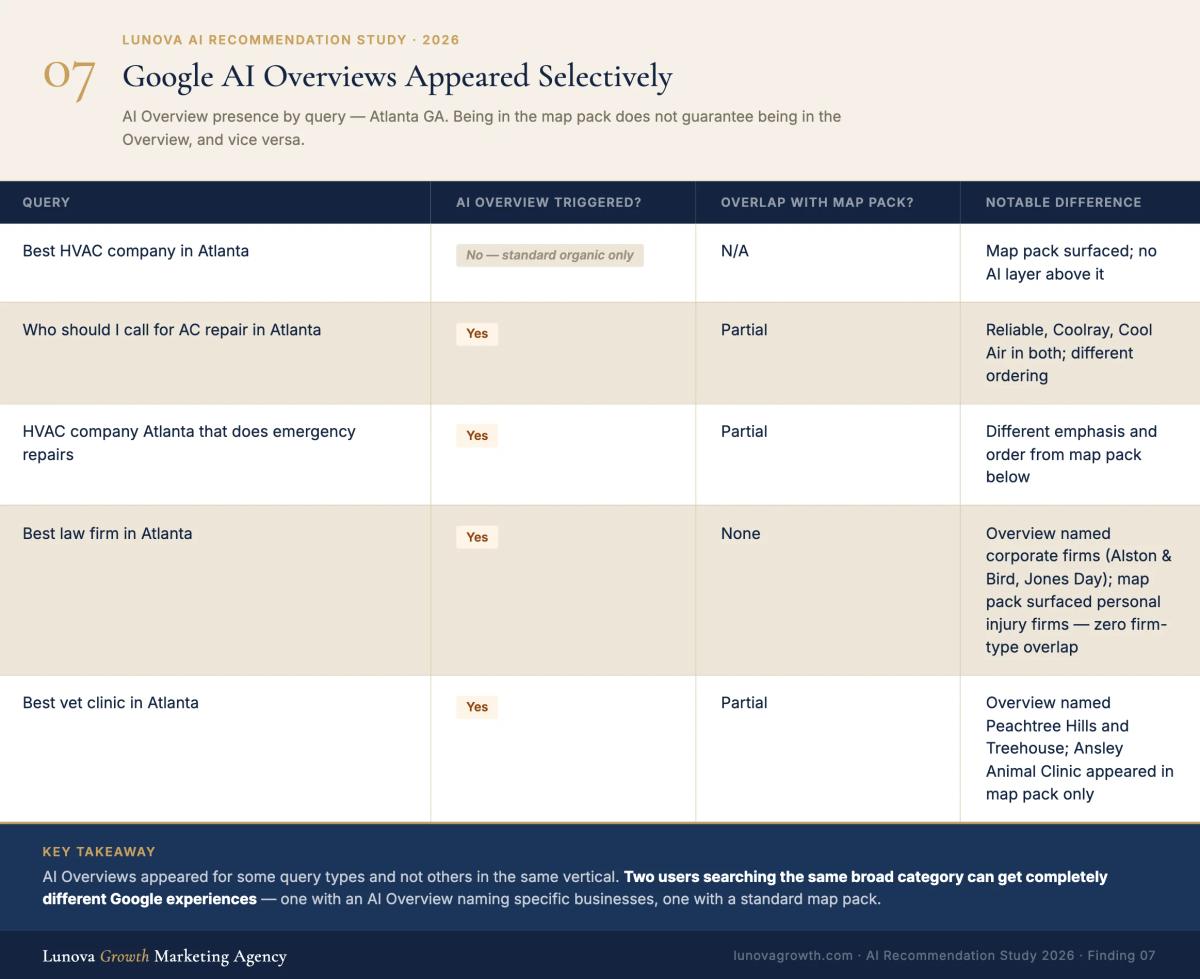
Google AI Overviews did not appear for every query we tested. The pattern across our data:
- Triggered for: "who should I call for AC repair in Atlanta," "HVAC company Atlanta that does emergency repairs," "best law firm in Atlanta," some general med spa queries
- Not triggered for: "best HVAC company in Atlanta" (standard organic results only), most Chattanooga and Flagstaff vet queries, most walk-in queries
AI Overview presence by query type:
- Best HVAC company in Atlanta: No AI Overview: standard organic and map pack only
- Who should I call for AC repair in Atlanta: AI Overview present: partial overlap with map pack (Reliable, Coolray, Cool Air surfaced in both)
- HVAC company Atlanta that does emergency repairs: AI Overview present: different ordering and emphasis from map pack
- Best law firm in Atlanta: AI Overview present, named Alston & Bird and Jones Day; map pack surfaced only personal injury firms
- Best vet clinic in Atlanta: AI Overview present, named Peachtree Hills and Treehouse; Ansley Animal Clinic appeared in map pack but not in Overview
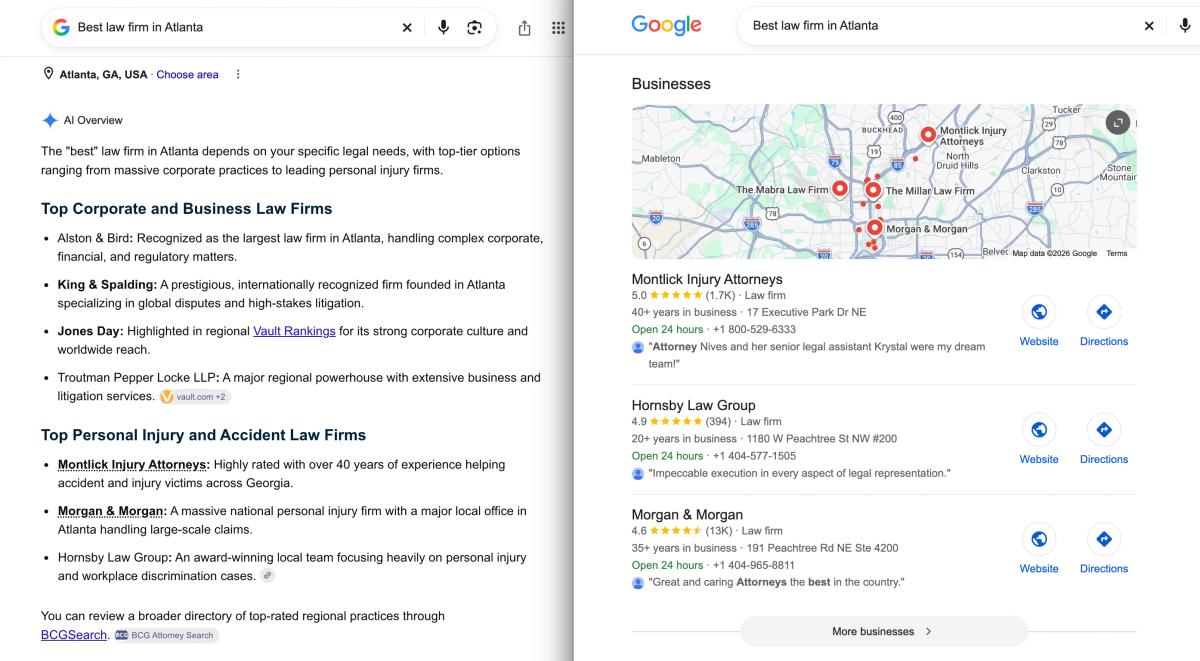
Two users asking the same broad question about your business category might get completely different Google experiences: one with an AI Overview naming specific businesses, one with a standard organic results page and map pack. Being in the map pack does not guarantee being in the Overview, and vice versa.
Finding 8: One Platform Surfaced a Permanently Closed Business
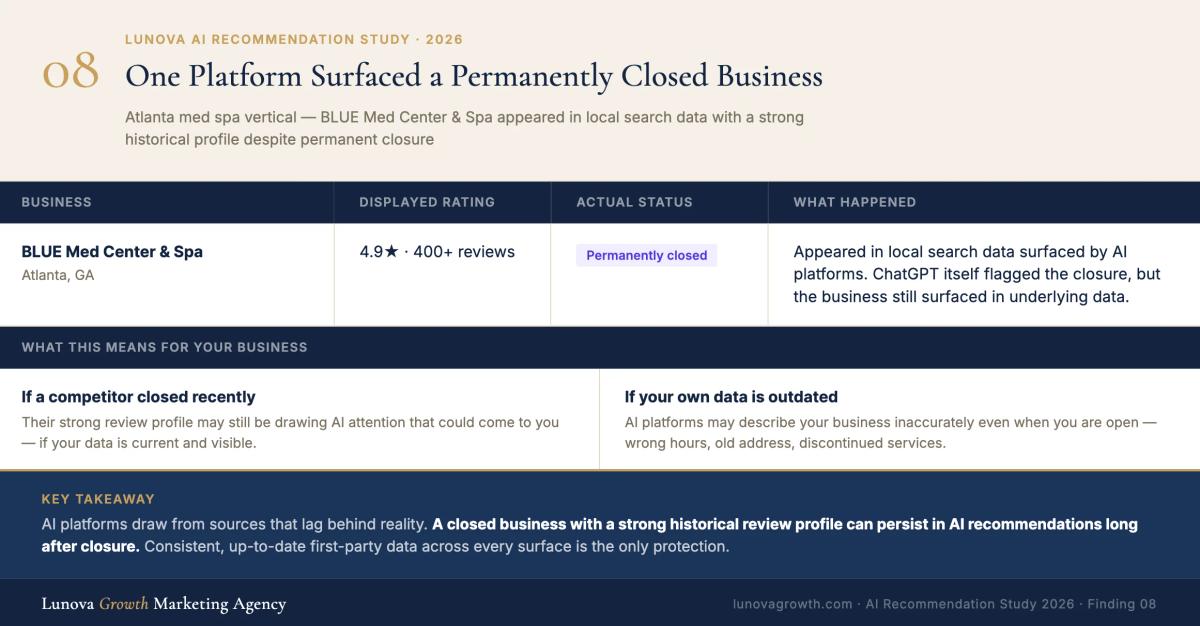
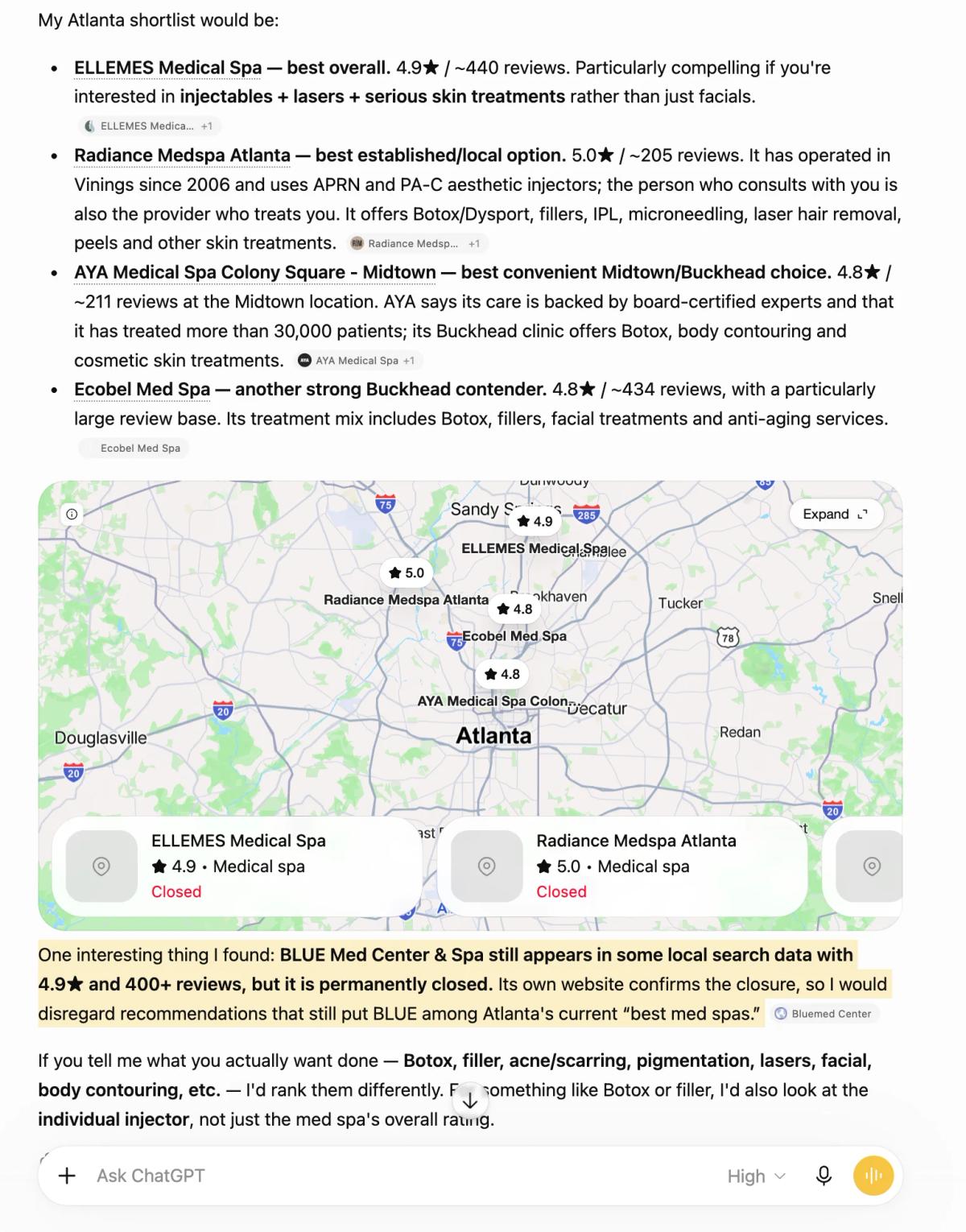
In our Atlanta med spa queries, one business appeared in local search data surfaced by AI platforms that no longer exists. BLUE Med Center & Spa showed up with a 4.9-star rating and over 400 reviews.
The business is permanently closed. Its own website confirms the closure. Notably, ChatGPT itself flagged this when it appeared, noting the business "is permanently closed" and recommending users disregard it.
A potential client who did not read that caveat, or who encountered the business through a platform that did not flag the closure, would have booked a consultation, driven to the address, and found nothing there.
AI platforms synthesize information from sources that may not reflect the current state of a business. A closed business with a strong historical review profile can persist in local search data long after its closure, because the underlying sources that AI platforms draw from have not caught up.
This finding cuts both ways for businesses in competitive markets:
- Your closed competitor may be absorbing AI visibility that could otherwise go to you
- Your own business, if your first-party information is inconsistent or outdated, may be described inaccurately even when you are very much still open
- Businesses that have rebranded, moved, or changed ownership face the same risk if old data persists in the sources AI platforms draw from
Finding 9: Flagstaff's Law Firm Results Showed Rare Cross-Platform Consensus
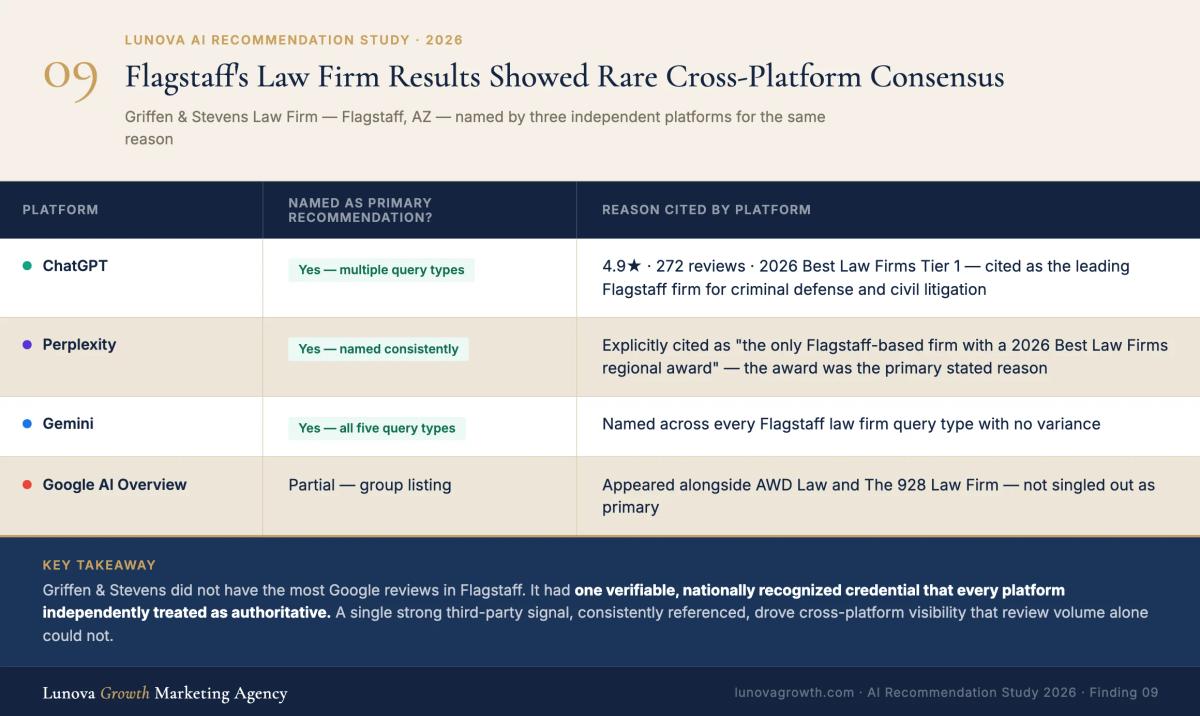
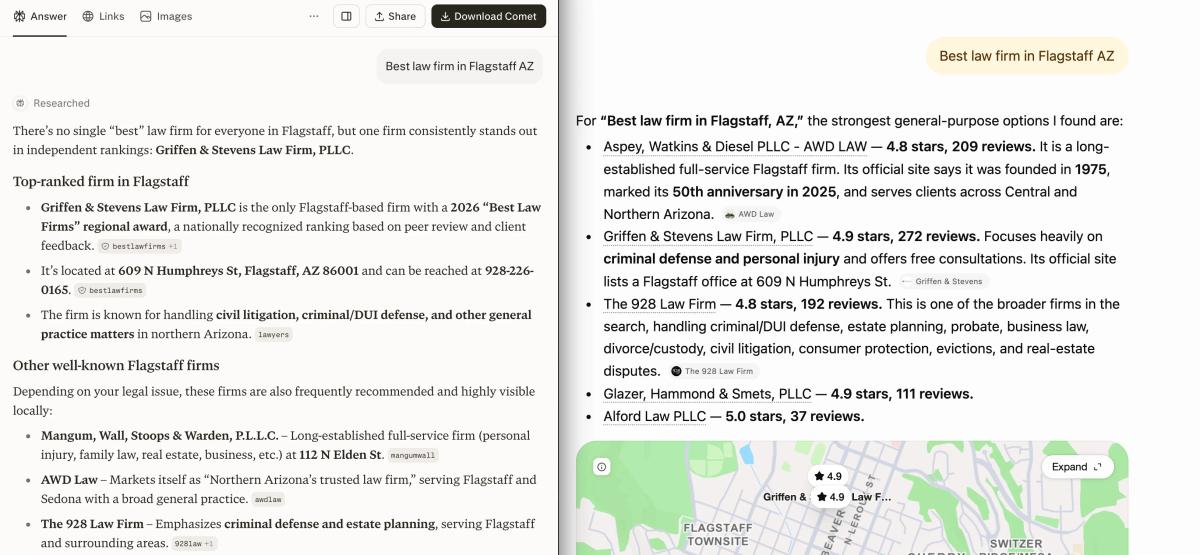
Most of the study shows disagreement between platforms. The Flagstaff law firm vertical was the exception. Griffen & Stevens Law Firm appeared as the primary recommendation across ChatGPT, Perplexity, and Gemini for multiple query types.
The reason: Griffen & Stevens is the only Flagstaff-based firm with a 2026 Best Law Firms regional award, a nationally recognized peer-review ranking that multiple platforms independently cited as the reason for the recommendation.
Cross-platform visibility for Griffen & Stevens Law Firm, Flagstaff AZ:
- ChatGPT: Named as primary recommendation across multiple query types: 4.9★, 272 reviews, 2026 Best Law Firms Tier 1
- Perplexity: Named consistently: cited as the only Flagstaff-based firm with the 2026 Best Law Firms regional award
- Gemini: Named across all five Flagstaff law firm query types
- Google AI Overview: Appeared in group listing alongside AWD Law and The 928 Law Firm
The business did not need to win every query type or have the most Google reviews. It had one strong, consistently referenced signal, and that signal propagated across platforms. This is the clearest data point in the study for what consistent cross-platform AI visibility looks like: a verifiable, third-party credential that multiple AI systems independently treat as authoritative.
Finding 10: Small Markets Produced Cleaner, More Consistent Results
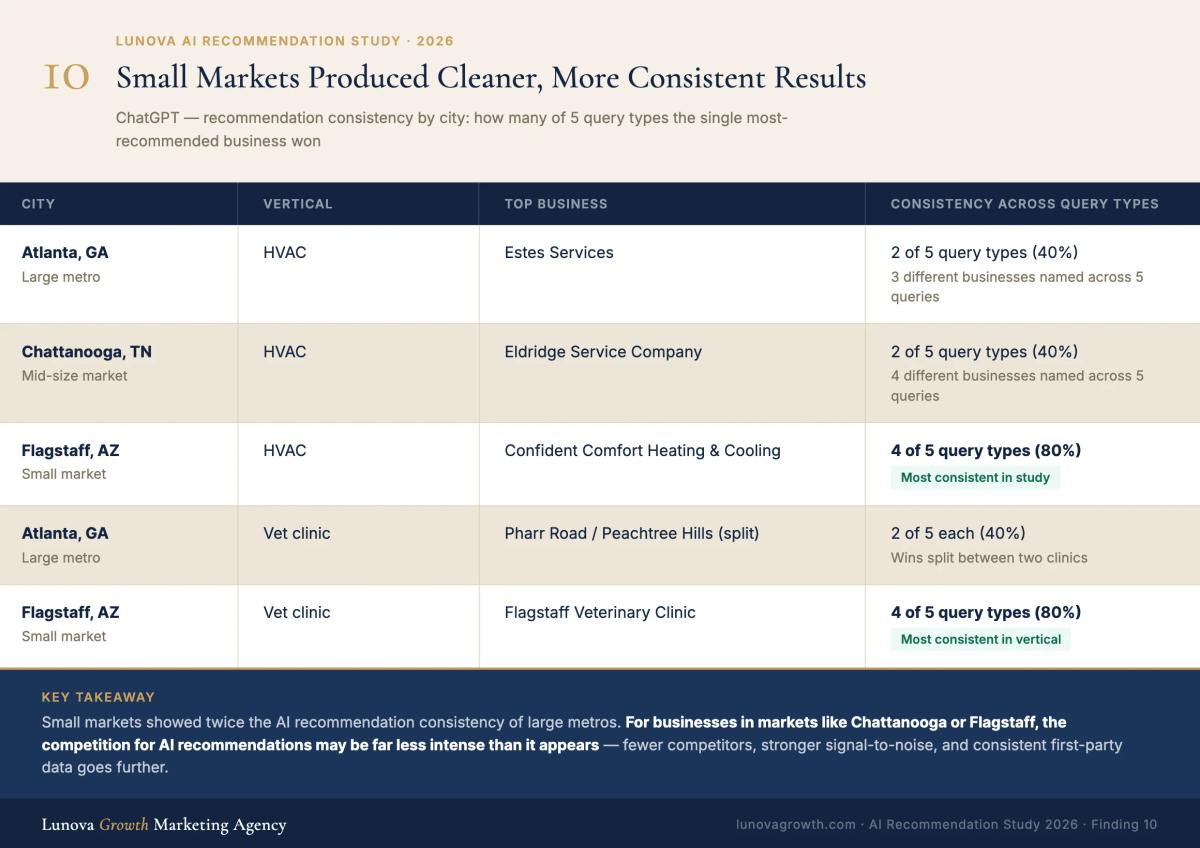
Atlanta, a large metro with hundreds of businesses in each vertical, produced the most variance. Different query types produced different winners. Platforms disagreed sharply. Walk-in and emergency queries surfaced entirely different businesses. Flagstaff produced the opposite.
ChatGPT recommendation consistency by city: how many of 5 query types the top business won:
- Atlanta, HVAC: Estes Services won 2 of 5 query types (40%)
- Chattanooga, HVAC: Eldridge Service Company won 2 of 5 query types (40%); four different companies named across five queries total
- Flagstaff, HVAC: Confident Comfort Heating & Cooling won 4 of 5 query types (80%)
- Atlanta, vet clinic: Pharr Road and Peachtree Hills split the wins: 2 of 5 each (40%)
- Flagstaff, vet clinic: Flagstaff Veterinary Clinic won 4 of 5 query types (80%)
This suggests that AI recommendations in small and mid-size markets may be more achievable for individual businesses. There are fewer competitors, the signal-to-noise ratio is better, and a strong local reputation with consistent first-party data is more likely to produce consistent AI visibility.
For businesses in markets like Chattanooga or Flagstaff, the competition for AI recommendations may be far less intense than it appears on the surface.
What the Data Shows About How AI Platforms Make Recommendations
After 60 queries across four platforms, some patterns in how AI platforms decide who to recommend are visible, though this study is not large enough to be definitive about the mechanics of any individual platform's algorithm.
- ChatGPT appeared to weight a combination of review volume, star rating, and first-party website content. Higher review volume won broader general queries. A perfect 5.0-star rating won rating-focused queries. Explicit availability language on the website won emergency and walk-in queries.
- Perplexity appeared to weight authoritative third-party citations more heavily: peer rankings, bar directories, professional association references. It was also more likely to decline a single recommendation for action-oriented queries in high-stakes verticals, defaulting to referral services instead.
- Gemini showed low variance for general query types, returning categorical lists regardless of whether the query said "best," "recommend," or "top-rated." It did shift for emergency and walk-in queries, surfacing 24/7 providers specifically.
- Google AI Overviews drew from a wider set of source types: web articles, directories, and local search data. It appeared to weight editorial sources (Vault rankings, Yelp lists, Reddit community mentions) more than the standalone platforms did.
Does ChatGPT Recommend Your Business? Here Is What to Do About It
AI visibility is not a single problem with a single solution. It is at least four separate problems, one per platform, each with different inputs, different behaviors, and different update cycles.
Getting recommended by ChatGPT does not mean you will be recommended by Perplexity. Showing up in a Google AI Overview does not mean you will appear when someone asks Gemini the same question. And the query someone types matters as much as which platform they use. Your business might appear for "best med spa in Atlanta" and be completely absent from "med spa in Atlanta that takes walk-ins."
The businesses that showed up most consistently across platforms and query types shared a set of characteristics:
- Strong review volume at a high rating. Not just a high star average; a meaningful number of reviews behind it.
- Explicit first-party availability information. Their website clearly stated walk-in hours, emergency availability, or new-patient acceptance: not buried, not implied.
- Third-party citations from credible, non-review sources. Industry awards, professional directory listings, peer rankings.
- Consistent, accurate information across every surface. Their website, their Google Business Profile, and the directories that AI platforms draw from all said the same thing.
That last point matters because of the closed-business finding. If your data is inconsistent or outdated anywhere in the map, AI platforms may describe your business inaccurately or recommend it for the wrong things, regardless of how strong your Google ranking is.
If you want to understand how your business appears across these platforms, a free Growth Audit from Lunova is a practical starting point. Our AI visibility service is built specifically around the signals that appeared most consistently in this study. We also have deeper breakdowns in our guides on how to show up in ChatGPT, how to get cited by AI, and what AI search means for local businesses.
Frequently Asked Questions
How many queries did you run in this study?
We ran 60 total queries across four service verticals (med spas, HVAC companies, law firms, and vet clinics), three cities (Atlanta GA, Chattanooga TN, and Flagstaff AZ), and five query types per combination. Each query was run separately on ChatGPT, Perplexity, Gemini, and Google AI Overviews, for a total of up to 240 individual platform outputs recorded.
Does ChatGPT recommend local businesses?
Does ChatGPT recommend local businesses, yes, in most cases when given a city-specific query like "best HVAC company in Atlanta." ChatGPT with browsing enabled pulls current local business data, including star ratings and review counts, and names specific businesses as recommendations.
The primary recommendation changes based on how the query is worded, so the same business may or may not appear depending on whether the query asks for "best," "top-rated," "who should I call," or an availability-specific variant.
Is ChatGPT's business recommendation the same every time?
Is ChatGPT's business recommendation the same every time, no. In our study, the same query type in the same city produced different primary recommendations when the wording changed.
In Atlanta's HVAC vertical, five different query types produced three different primary recommendations on ChatGPT. Outputs can also vary across separate sessions due to changes in local business data and normal output variation.
Why does Perplexity recommend different businesses than ChatGPT?
Perplexity recommends different businesses than ChatGPT because the two platforms draw from different underlying sources and apply different reasoning. ChatGPT appears to weight local review data heavily for service business queries.
Perplexity appears to weight authoritative third-party citations more heavily: peer rankings, professional directories, bar association references. It also behaves differently depending on query intent, naming specific firms for research-oriented queries but redirecting to referral services for action-oriented ones in high-stakes verticals like legal services.
Does Google AI Overview replace local search results?
Does Google AI Overview replace local search results, not entirely. In our study, AI Overviews appeared selectively, not on every query. When they did appear, the businesses named in the Overview did not always match the businesses shown in the map pack directly below it. Both surfaces appear to have independent inputs. Getting into one does not guarantee getting into the other.
What makes a business show up across multiple AI platforms?
What makes a business show up across multiple AI platforms, based on the patterns in this study, is a combination of factors: a strong review profile (high volume at a high rating), explicit first-party information about services and availability, and third-party citations from credible non-review sources such as industry rankings or professional directories.
Consistent and accurate business data across every surface that AI platforms draw from is also part of it. The Flagstaff law firm vertical showed that a single strong third-party credential, consistently referenced, can drive cross-platform visibility even without the highest review volume.
Can I optimize my business to appear in AI recommendations?
You can optimize your business to appear in AI recommendations, yes, to a meaningful degree based on what this study shows. Review volume and rating matter most for ChatGPT's general queries.
Third-party citations from authoritative directories and rankings matter for Perplexity. Explicit, well-structured first-party information on your website matters for availability-focused queries across all platforms.
Consistent and accurate business information across your website, Google Business Profile, and the directories that AI platforms draw from reduces the risk of being described inaccurately. Our guide to AI search for local businesses and our local SEO service cover the specific steps in more detail.