
What Decides Whether ChatGPT Names Your Business
You searched your own service and city in ChatGPT. Your business didn't come up. Here's what that list is actually based on, and what changes it.
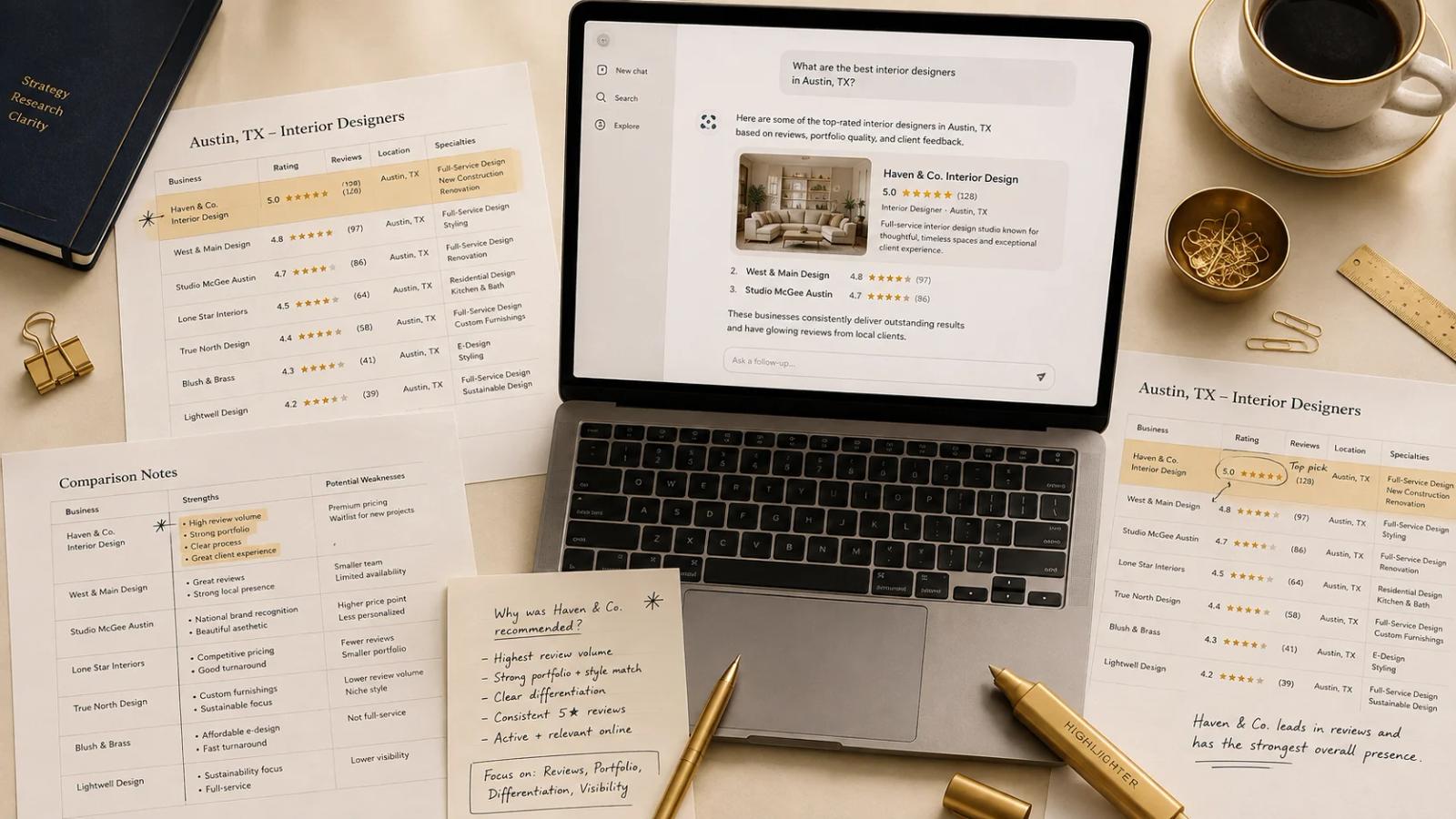
Run the test right now if you haven't already. Open ChatGPT, type "best [your service] in [your city]," and read whatever comes back. If your business isn't in the answer, you're not alone. Most service businesses aren't. What's worth understanding is why the ones that are showing up got there, because it's not what most owners assume.
ChatGPT's local business recommendations don't work like a Google search. There's no keyword ranking, no paid placement, no algorithm you optimize with backlinks. The businesses that appear in those answers got there because the platform had enough reliable, structured information about them to confidently put their name in a response.
This article breaks down how that actually works, what signals ChatGPT reads for local recommendations, and what a service business owner can do about it.
One honest caveat upfront: ChatGPT answers are more variable than most business owners realize. SparkToro and Gumshoe research (2,961 prompts, November–December 2025) found a less-than-one-in-100 chance that the same brand list appears twice for the same prompt.
That means there's no single "position" to win, but there is a meaningful difference between businesses that appear frequently and businesses that almost never appear.
How ChatGPT Sources Local Business Recommendations
ChatGPT isn't a search engine. It doesn't crawl the web in real time and rank results. It generates responses based on patterns in its training data and, for versions with browsing enabled, live web queries through Bing. That distinction matters a lot for local businesses.
For the base ChatGPT model without browsing, recommendations come from training data absorbed before the model's cutoff date — OpenAI releases updated model versions periodically with newer data. That data includes business listings, review platforms, local directories, news mentions, and web content that described a business authoritatively enough to be included.
A business with thin online presence simply doesn't exist in that training set in any meaningful way.
For ChatGPT with browsing enabled, the picture changes. The model can pull live web results, which means current GBP data, recent reviews, and up-to-date directory listings all become relevant.
Even here, the model is looking for signals that let it speak with confidence. Ambiguous, inconsistent, or sparse data produces hesitation. Clear, consistent, frequently-cited data produces recommendations.
Why Browsing Enabled vs. Browsing Off Changes Everything
Many users run ChatGPT without browsing. Others have it on by default. The distinction matters because the two modes effectively create two separate recommendation pools for your business.
Without browsing, ChatGPT answers from memory. A business that wasn't generating consistent online signals before the model's training cutoff may simply not exist in a useful way in the base model's knowledge. Recency doesn't help here. A flood of new reviews won't retroactively rewrite training data.
With browsing enabled, ChatGPT searches the web and synthesizes a response. That makes it more like Perplexity: current signals matter, and a business with a well-maintained GBP, active review stream, and consistent directory presence has a real shot at appearing.
The good news is that most of the work you do to improve AI visibility helps both modes over time. The base model gets retrained on newer data; browsing picks up current signals immediately.
What Signals ChatGPT Actually Reads
The signals that push a local service business into ChatGPT recommendations overlap significantly with local SEO signals, but the weighting is different. An AirOps study of 15,000 prompts found that roughly 85% of pages ChatGPT retrieves are never cited in the final response — meaning retrieval is just the first filter, not the finish line.
- Google Business Profile completeness. GBP is the single most-cited source for local business data across AI platforms. A complete profile with accurate categories, service descriptions, hours, and photos gives AI systems a clean, structured summary of what a business does and where it operates. An incomplete GBP creates ambiguity that AI systems resolve by citing someone else.
- Review volume and recency. A business with a high star count from three years ago is less AI-citation-friendly than one with a steady stream of recent reviews. AI systems treat active, recent engagement as a proxy for business health and trustworthiness. "This business had 40 reviews last quarter" reads very differently in training data than "this business has 400 reviews, the most recent from two years ago."
- Citation consistency across directories. When your business name, address, and phone number appear consistently across Yelp, Bing Places, Apple Maps, Foursquare, and other directories, AI systems can cross-reference that data and build a confident picture of your business. Inconsistencies, whether from a moved location, a name change, or just sloppy listings management, create noise that makes AI systems less willing to commit to a recommendation.
- Structured service descriptions. "We offer HVAC services throughout the metro area" is hard for an AI system to parse into a specific recommendation. "Our licensed HVAC technicians provide central air installation, furnace repair, and emergency service calls for residential and commercial clients in Denver, Aurora, and Lakewood" gives the model specific, quotable information about what the business does and where.
- FAQ content on your site. Direct question-and-answer content that mirrors what people ask AI assistants performs disproportionately well in AI citation. If your website answers "how much does HVAC repair cost in Denver?" or "what does a med spa consultation include?" in plain, direct language, those answers become candidates for inclusion in ChatGPT responses.
What's Unique to AI Recommendation vs. Regular SEO
Traditional SEO rewards long-form, keyword-rich content, topic depth, and backlink authority. AI recommendation rewards something adjacent but distinct: structured specificity. An AI system needs to be able to say something definitive about your business, and that requires content it can quote rather than content it has to summarize.
The clearest way to think about it is this: SEO optimizes for ranking. AI visibility optimizes for quotability. A business can rank well on Google and still fail to appear in ChatGPT recommendations if its content is too generic, too flowing, or too vague to be cited directly.
Prior work by Lunova's senior specialists produced some of the clearest evidence of this. Structured content changes on a competitive platform produced a 460% increase in AI Overview citations in a single month, from roughly 50 citations to 280-plus, verified in Ahrefs.
The changes weren't about new keywords. They were about reformatting existing content into structures AI systems could actually read and repeat. For a deeper look at how that formatting works across platforms, getting cited by AI breaks it down in detail.
One technical note worth knowing: OpenAI runs three separate bots. GPTBot collects training data; OAI-SearchBot builds the index behind ChatGPT Search citations; ChatGPT-User fires only on live user fetches.
The bot that controls whether you appear as a cited source in ChatGPT Search is OAI-SearchBot, and blocking all AI bots wholesale in robots.txt can silently remove you from citations while you only meant to opt out of training.
A 5-Point Audit to Run Right Now
Before spending anything on AI visibility work, run these five checks on your own business. They take less than an hour and will tell you where the biggest gaps are.
- Search yourself in ChatGPT. Try at least three queries: "best [service] in [city]," "recommend a [service provider] near [city]," and "[your specific service type] [city]." Document what comes back. Do competitors appear? Does anyone appear? What language does ChatGPT use to describe the businesses it names?
- Open your GBP and count the empty fields. Categories, service descriptions, attributes, opening hours for every day of the week, photo count, and whether your Q&A section has any answered questions. Every blank field is a gap in what AI systems can say about you.
- Check three major directories for consistency. Pull up your Yelp, Bing Places, and Apple Maps listings. Compare your business name, address, and phone number across all three. Any variation is a signal problem.
- Read your website's homepage and main service page as if you're an AI. Is the business name stated clearly? Is the city and service area named explicitly? Are specific services named or buried in vague language? Is there any direct question-and-answer content?
- Check your review velocity. How many reviews did you receive in the last 90 days? Compare that to a competitor that ChatGPT did name. Active review generation is usually one of the fastest-moving signals to fix.
Why Showing Up for One Query Doesn't Mean Showing Up for All
This is worth understanding before setting expectations. ChatGPT's responses vary by query phrasing, browsing status, the user's geographic context, and when the model was last updated.
A business that appears in a "best HVAC company in Denver" query might not appear in "who should I call for emergency furnace repair in Denver." The second query is more specific, and the platform pulls from a different subset of its knowledge.
That query-type effect is consistent across platforms and verticals. In Lunova’s own 60-query test across ChatGPT, Perplexity, Gemini, and Google AI Overviews, the same city and vertical produced up to four different primary recommendations depending on how the question was phrased.
AI visibility isn't a binary: it's a distribution of appearance probability across query types. Ahrefs found that Google AI Mode and AI Overviews cite different sources 87% of the time for the same query, so appearing in one doesn't mean appearing in the other.
For a platform-by-platform breakdown, the AI search for local business guide covers the mechanics across Google AI Overviews, ChatGPT, and Perplexity. That's why the work tends to compound over time rather than produce a one-time result.
For service businesses that want a systematic approach, Lunova's AI visibility service covers the full signal audit, citation repair, structured content production, and ongoing monitoring across ChatGPT, Perplexity, and Google AI Overviews.
We've also run the actual query test at scale, checking which business types appear and which don't, across cities and verticals. That research is what drives the ChatGPT study we ran on 60 local business queries.
What Actually Changes Your ChatGPT Presence
Based on the signal patterns above, the highest-use work for most local service businesses breaks into three categories:
First, close the GBP gaps. Complete every field, add service-specific descriptions that name your exact services and locations, and build a systematic review generation process. This is the foundation that everything else runs on, and it's where most businesses find the fastest movement.
Second, restructure your service pages for quotability. Replace vague service descriptions with specific ones. Add a FAQ section that answers the questions your prospects actually ask ChatGPT. Name your service areas explicitly in the page content rather than leaving them implied. The more specific and direct your content is, the more quotable it becomes.
Third, fix citation consistency across the directories AI systems reference most. Yelp, Bing Places, Apple Maps, Foursquare, and any industry-specific directories relevant to your vertical should all show the same business name, address, and phone number. Spend an afternoon on this and don't skip it.
The businesses showing up in ChatGPT recommendations ahead of you aren't necessarily doing more marketing. They've usually got cleaner data and more structured content.
Those are fixable problems once you know where you stand. Reach out to Lunova Growth Marketing Agency today, and our free Growth Audit will show you exactly which signals are holding your business back from those recommendations.
Frequently Asked Questions
How does ChatGPT decide which local businesses to recommend?
ChatGPT decides which local businesses to recommend based on the quality, consistency, and structure of the business data available to it. For the base model, this means training data drawn from business listings, review platforms, directories, and web content.
For browsing-enabled versions, it means live web results weighted by the same signals: GBP completeness, review volume and recency, citation consistency, and structured content that's specific enough to quote with confidence.
Does having a Google Business Profile help you show up in ChatGPT?
Having a complete Google Business Profile does help you show up in ChatGPT, particularly for browsing-enabled versions and for Google's own AI Overviews. GBP is one of the most heavily indexed sources for local business data.
An incomplete or inaccurate GBP reduces confidence in the AI system's ability to speak about your business, and often pushes recommendations toward competitors with cleaner data.
Why does ChatGPT recommend my competitor but not me?
ChatGPT recommends your competitor but not you almost always because the competitor has better-structured data available to the model. That usually means a more complete GBP, more recent reviews, consistent citations across directories, or service page content specific enough to be quoted directly.
It's rarely about advertising spend or having a higher star rating overall. It's about data clarity.
Can I pay to show up in ChatGPT recommendations?
You can't pay to show up in organic ChatGPT recommendations. ChatGPT doesn't have a local business advertising product the way Google does. The recommendations are generated from the model's knowledge and web browsing, not from a paid placement system. Optimizing for AI visibility means improving the organic signals the model reads, not buying a spot in the answer.
How often does ChatGPT update its local business data?
ChatGPT updates its local business data on two different cycles. The base model's training data has a cutoff and updates periodically through new model releases, which means changes to your online presence may take months to show up in base model responses.
The browsing-enabled version updates much faster, pulling live web results that can reflect GBP and directory changes within weeks. Building strong current signals matters even when you can't control training data timing.