
AI Search Is Changing Who Finds Local Businesses
Google is answering more queries directly. ChatGPT is fielding searches that used to go to search engines. The businesses appearing in these answers aren't always the highest-ranked on Google. Here's what changed and why it matters.
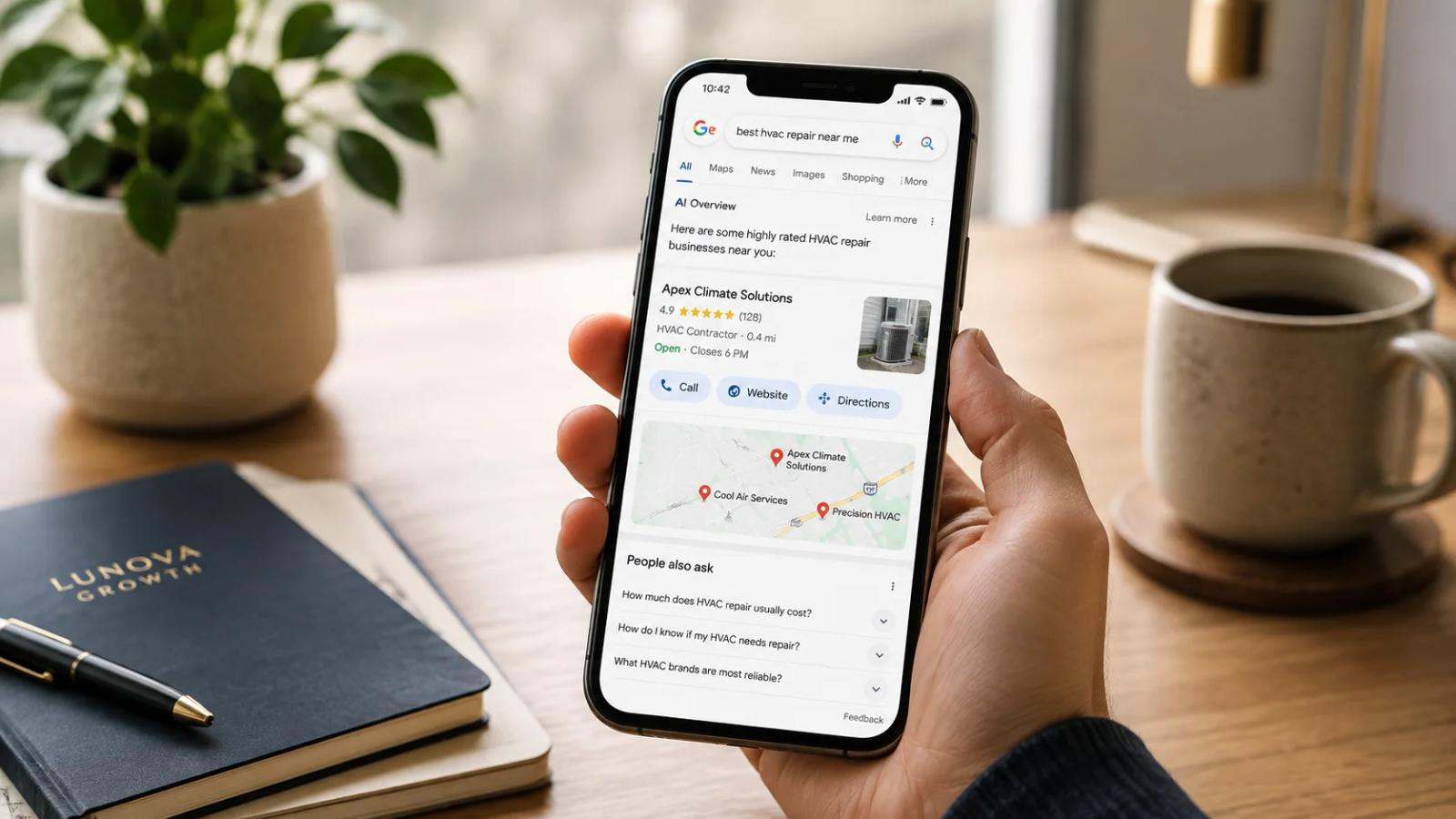
Something changed in how local businesses get found, and most owners haven't noticed yet. The change isn't sudden. Google has been answering more queries directly in the results page for years.
ChatGPT crossed 200 million users, and a meaningful share of them are using it for local searches that used to go to Google: "recommend a good HVAC company near me," "what's a reputable med spa in [city]," "who's a reliable vet for my dog?"
The businesses appearing in those AI-generated answers aren't ranked by the same algorithm Google uses for organic search. They're selected based on different signals, and most of the service businesses showing up there didn't optimize for it intentionally. They just happened to have the right data in the right places.
This article is for the service-business owner who has started to notice this shift but doesn't yet have a framework for thinking about what it means. We'll cover what AI search actually is for a local business, how the major platforms differ, what signals drive AI local recommendations, and what the three most impactful things to fix first look like in practice.
What AI Search Actually Is, in Plain Terms
The scale of the shift shows up in the behavior data. Pew Research tracked 68,879 real searches by 900 US adults in early 2025 and found users clicked any web result only 8% of the time when an AI summary appeared, versus 15% without one. A separate SparkToro analysis found 68% of US Google searches ended without any click at all in early 2026.
For a local service business, this means the question is no longer just "where do I rank?" — it's "does the AI mention me at all?"
AI search is what happens when a user asks a question and gets a synthesized answer instead of a list of links to click through. The answer draws from multiple sources, structures them into a coherent response, and often names specific businesses, services, or recommendations directly.
That's a different experience from typing a query into Google and getting ten blue links. A user who receives an AI-generated answer that names two HVAC companies doesn't need to click through ten results. They have an answer and possibly a business name. The businesses not named in that answer don't exist for that user in that moment, even if they rank on page one of organic search.
For local service businesses specifically, this matters because the query types that AI assistants handle well are exactly the ones service-business clients use: "who should I call," "what's a good [service] near me," "recommend a [business type] in [city]."
These are high-intent queries from people who are ready to book, and they're increasingly going to AI systems rather than traditional search. If you’re keen to learn more, we actually tested this across 4 different platforms ourselves and compiled ten interesting findings.
How the Major Platforms Differ
Pew's 2025 study found AI Overviews triggered on 18% of the searches they tracked. Ahrefs's analysis of 146 million SERPs found AI Overviews appear on about 20.5% of keywords overall — with a much higher rate on question-format queries. ChatGPT now has over 900 million weekly active users globally. The platforms behave differently in ways that matter for how local businesses prepare.
Not all AI search works the same way, and the differences matter for understanding which signals to prioritize.
Google AI Overviews are the most consequential for local businesses right now, simply because of where they appear. They show up at the top of Google search results, before organic listings, on queries where Google's system determines an AI-generated summary is more useful than a list of links.
Google AI Overviews pull from Google's own index in real time, which means they respond quickly to changes in your GBP, your website content, and your structured data. Businesses with complete, structured, active profiles are the ones surfacing in these answers.
ChatGPT operates differently depending on which version a user is running. ChatGPT's base model without browsing draws from training data with a cutoff date, so it reflects what was known about a business up to a point in the past.
The browsing-enabled version behaves more like a search engine: it queries the web live, synthesizes results, and shows its sources. For local business recommendations specifically, browsing-enabled ChatGPT is increasingly common and behaves similarly to Perplexity in its reliance on current web signals.
Perplexity is built around source attribution. Every claim it makes links to a source, and the platform queries live web results by default. It functions as a research tool more than a chat interface, which means businesses with well-structured, frequently-cited content perform better in it.
Perplexity is smaller than ChatGPT or Google but draws a highly engaged user base. It's where some of the clearest AI citation patterns are easiest to study because sources are explicit.
Voice search, handled by Siri, Google Assistant, and Alexa, represents a fourth channel. Voice queries are almost always local and immediate ("find me a plumber open right now," "call the best dog groomer near me"), and the answers come from a single recommendation rather than a list.
The signals that produce voice recommendations overlap heavily with Google AI Overviews: GBP completeness and local prominence are the dominant factors.
The Signals AI Assistants Read for Local Businesses
This is the section that most directly affects what you do next, so it's worth going through carefully. AI systems don't evaluate local businesses the same way a human would review a website. They read structured data, cross-reference sources, and build a confidence score about whether a business is real, active, and relevant to a given query.
The signals that matter most, roughly in order of impact for most local service businesses:
Google Business Profile completeness. GBP is the most-crawled source of local business data across every AI platform. A complete profile with accurate categories, a detailed service description, specific service entries, up-to-date hours, photos, and answered questions tells AI systems what your business does, where it operates, and that it's actively maintained.
An incomplete or outdated GBP creates ambiguity that AI systems resolve by citing businesses with cleaner data. Your Google Business Profile is the single most important starting point for AI visibility.
Review velocity and recency. A static star rating from three years ago means less to AI systems than an active review stream from recent months. Review velocity signals that a business is operating, that clients are using it, and that those clients are motivated enough to report on the experience. AI systems treat active review streams as a proxy for business health and customer trust.
Citation consistency across directories. When your name, address, and phone number (NAP) appear consistently across Yelp, Bing Places, Apple Maps, Foursquare, and other directories, AI systems can cross-reference that data and build a confident picture of your business.
Inconsistencies from a moved location, a name change, or incomplete listings create conflicting signals that reduce confidence and suppress recommendations.
Structured content on your website. AI systems favor content formatted as direct question-and-answer pairs, with specific named services, named locations, and concrete details that can be quoted. A service page that says "we offer HVAC services to residential clients" is harder to cite than one that names specific cities and specific services.
"Our licensed HVAC technicians serve Denver, Lakewood, and Aurora for central air installation, furnace repair, and 24-hour emergency calls" gives an AI system specific, quotable facts. The first version gives it nothing to work with.
FAQ schema markup. Adding structured FAQ markup to your service pages tells AI crawlers exactly where your question-and-answer content lives. Pages with FAQ schema surface in Google AI Overviews at significantly higher rates than equivalent pages without it. It takes a developer a few hours to implement and the difference in AI citation rates is meaningful.
Named entity clarity. AI systems build a picture of a business from every authoritative source that mentions it. A business with thin entity presence, appearing only on its own website with minimal external mentions, is harder for AI systems to identify and cite with confidence.
A business with consistent mentions across directories, review platforms, local news, and relevant industry sites presents a clearer entity for AI systems to draw from.
Why Traditional SEO Rankings Don't Automatically Carry Over
One reason rankings don't auto-transfer: AI systems frequently get facts wrong, even for businesses that rank well. The Columbia Tow Center tested eight AI search tools across 1,600 queries and found over 60% of responses had citation errors.
That accuracy gap is why the signals AI systems use to source local businesses (GBP completeness, structured content, citation consistency) matter alongside organic rankings, not instead of them.
This is the part that surprises most service-business owners who've invested in SEO. Ranking on page one of Google for your primary keyword does not guarantee your business will appear in AI-generated answers. The two systems are related but operate on different logics.
Google rankings reward page authority, keyword relevance, backlink profiles, and on-page optimization for the query. AI citations reward data clarity, content structure, entity consistency, and quotability. A business can be excellent at one and poor at the other.
The most common version of this problem looks like this: a service business has invested in a content-heavy website with strong keyword rankings, but the content is written in flowing prose without direct FAQ answers, the GBP hasn't been touched in two years, and the business appears inconsistently across directories.
Google still ranks them because the page authority is there. AI systems don't cite them because they can't cleanly parse and quote the content they find.
The reverse also happens. A newer business with modest Google rankings but a complete, active GBP, consistent citations, and structured service page content can appear in AI Overviews ahead of more established competitors. The signal gap closes faster for AI visibility than for organic rankings, which is part of why this represents an opportunity for service businesses that act on it early.
The Overlap Between Google SEO and AI Search Readiness
The relationship between organic rankings and AI citations is real but looser than most assume. Ahrefs's updated analysis (863,000 keywords, ~4 million AI Overview URLs) found only 38% of AI-cited pages also rank in the top 10 for that query — down from 76% in their July 2025 study. The majority of AI citations now come from outside the top 10.
That's both a warning (ranking well doesn't guarantee AI visibility) and an opportunity (a well-structured page can get cited without ranking near the top).
The gap between traditional SEO and AI visibility is real, but so is the overlap. Both reward a complete, active GBP. Both value consistent citations across directories. Both respond positively to clear, specific content that answers questions directly. The difference is in emphasis and format.
Standard SEO work, particularly local SEO, builds the foundation that AI visibility runs on. A business that has done strong local SEO, with a complete GBP, a clean citation profile, and well-structured service pages, is already most of the way toward AI visibility.
The remaining gap is usually in content structure: converting flowing prose into FAQ-style content, adding schema markup, and making service descriptions specific enough to be quotable.
If you're starting from scratch, local SEO and AI visibility overlap enough that the work compounds across both. If you have an existing SEO foundation, the gap to AI visibility is narrower than you might expect. The local SEO work and the AI visibility work belong together, not in separate retainers.
The Three Things to Fix First
If you take nothing else from this article, these three priorities will move the needle on AI local search visibility faster than anything else for a service business starting from a typical baseline.
First: complete your GBP thoroughly. Not "claimed and minimally filled out," but fully complete. Add specific service entries for everything you offer. Write a service description that names your services and your service areas explicitly. Fill in attributes, update hours, answer questions that have come in, and upload recent photos.
This is the single highest-impact action for AI local visibility, and it costs nothing to do.
Second: add a real FAQ section to your primary service page. Five to eight questions that your actual clients ask, with direct, specific answers in plain language. Implement FAQ schema on that page after adding it. This alone can produce AI Overview appearances within four to eight weeks on queries you weren't appearing for before.
Third: audit your NAP consistency across the top five directories. Check Google Business Profile, Yelp, Bing Places, Apple Maps, and Foursquare. If your business name, address, or phone number appears differently in any of them, fix it.
This is unglamorous work, but it's one of the fastest ways to increase AI recommendation confidence, and most service businesses find at least one inconsistency when they actually check.
Beyond these three, the work gets more nuanced: structured content production, entity expansion, review velocity programs, and ongoing monitoring across AI platforms. For service businesses that want to build AI search visibility systematically, Lunova's AI visibility service covers the full audit and ongoing work. But these three fixes are ones you can start on today without any outside help.
AI Search and Local Discovery: What the Shift Means Long-Term
The service businesses showing up in AI recommendations in 2026 are building a position that will be increasingly difficult for late-movers to displace. The signal depth required, combining complete GBP, active reviews, consistent citations, and structured content, takes months to build properly.
Businesses that start that work now are compounding it while competitors are still watching to see whether AI search matters.
The analogy to Google's local map pack is useful here. In 2012, most service businesses weren't optimizing for local search or Google Business Listings (as GBP was then called). The businesses that did it early built positions in the map pack that their competitors then had to fight to displace over years. AI search recommendations are at a similar inflection point right now.
For a closer look at how to show up in ChatGPT recommendations specifically, showing up in ChatGPT breaks down the platform mechanics. For the content structure side, getting cited by AI covers what makes content quotable across all three major platforms.
If you'd like to know where your specific business stands before deciding what to prioritize, reach out to Lunova Growth Marketing Agency today. Our free Growth Audit maps your AI search gaps alongside your broader local SEO picture.
Frequently Asked Questions
What is AI search and how is it different from Google?
AI search is what happens when a user asks a question and receives a synthesized answer instead of a list of links. Traditional Google search returns a ranked list of pages for the user to click through; AI search generates a response that may name specific businesses, quote specific content, or make specific recommendations without requiring multiple page visits.
The difference matters for local businesses because AI search often surfaces a short list of recommendations rather than ten ranked results. Presence in that short list is more valuable and harder to achieve through standard SEO alone.
Does my Google ranking affect whether I show up in AI search?
Your Google ranking does affect AI search, but the relationship is not direct. A strong organic ranking helps because it indicates page authority and relevance, both of which AI systems use as positive signals.
However, a business can rank well organically and still fail to appear in AI-generated answers if its content isn't structured for AI citation: generic service descriptions, no FAQ sections, incomplete GBP, and inconsistent directory citations all suppress AI visibility even when organic rankings are solid. The overlap is real; the gap is in content structure and data quality.
Which AI platforms matter most for local business recommendations?
Google AI Overviews matter most for local business recommendations right now, because they appear in Google search results where local intent queries already land. ChatGPT with browsing enabled is second in reach and growing; the base model matters too, though it responds more slowly to changes.
Perplexity is smaller in user volume but highly relevant for service businesses because it's used by engaged researchers and shows explicit source citations. Voice search via Siri and Google Assistant rounds out the picture for immediate, single-recommendation queries.
Prioritizing Google AI Overviews and browsing-enabled ChatGPT covers most of the opportunity for service businesses starting this work.
What signals do AI assistants use to find local businesses?
AI assistants use a combination of signals to find and recommend local businesses: GBP completeness and category accuracy, review volume and recency, citation consistency across directories, website content structure (particularly direct question-and-answer formatting and FAQ schema), named entity clarity, and the specificity of service and location descriptions.
The common thread is that AI systems build confidence from clear, consistent, specific data. A business that scores well across all of those signals is more likely to be recommended than one that scores high on one signal but weak on the others.
Do I need a separate strategy for AI search, or does regular SEO cover it?
You need a complementary strategy, not an entirely separate one. Regular local SEO work, including GBP optimization, citation building, and structured service pages, builds the foundation that AI visibility depends on.
What most standard SEO approaches miss is the content structure layer: converting prose into FAQ-formatted content, implementing FAQ schema, and writing service descriptions specific enough to be quoted directly.
If you're already doing strong local SEO, the gap to AI visibility is probably narrower than you think. If your SEO foundation has gaps, fixing them improves both organic rankings and AI visibility at the same time.
Is AI search replacing Google for local business discovery?
AI search is not replacing Google for local business discovery so much as it's being absorbed into Google. Google AI Overviews are part of Google search, not a separate platform. What's changing is how Google presents results for certain query types, with an AI-generated answer appearing above organic results on an increasing share of local queries.
ChatGPT and Perplexity are genuine alternatives that some users are choosing over Google for local research, but Google remains the dominant platform. The practical implication is that optimizing for AI visibility within Google, primarily through GBP, structured content, and FAQ schema, is where most of the accessible opportunity sits right now.