
Getting Cited by AI Comes Down to Being Quotable
Two businesses, same city, same reviews, similar GBP. One gets cited by AI Overviews and ChatGPT constantly. The other never does. The difference isn't domain authority. It's content structure.
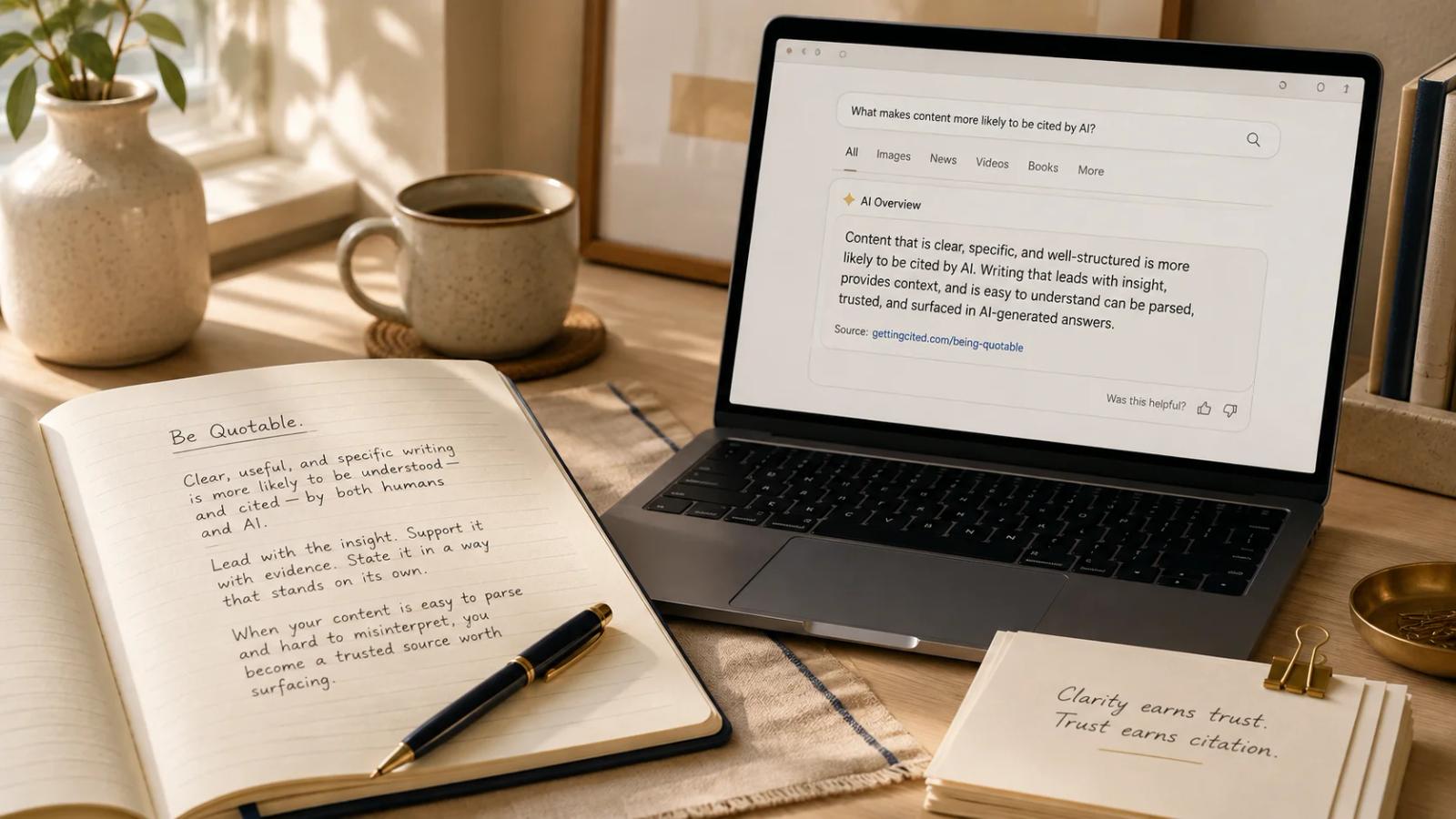
Take two service businesses in the same city, same vertical, similar star ratings and GBP setups. One gets cited by AI Overviews regularly. ChatGPT names it when users ask for local recommendations. Perplexity pulls from its service pages. The other business never appears, despite spending more on SEO and running paid ads alongside it.
The difference isn't domain authority, ad spend, or the number of reviews. It's content structure. One business produces content that AI systems can quote. The other produces content that AI systems read but can't easily use.
This article covers what makes content AI-quotable across platforms, why the format matters as much as the information itself, and what a service business can do today to move toward being cited rather than overlooked.
The Result That Made the Pattern Obvious
Prior work by Lunova's senior specialists showed this pattern in its starkest form. A competitive platform had solid content, decent domain authority, and no obvious gaps in its SEO setup. But it was generating fewer than 50 AI Overview citations per month.
Over one month, the content team restructured existing pages: breaking flowing prose into question-and-answer pairs, adding FAQ schema markup, naming specific entities more precisely, and tightening service descriptions from vague to specific. No new pages. No link building. No keyword strategy changes.
The result was a 460% increase in AI Overview citations, from roughly 50 to 280-plus, verified in Ahrefs. The content was already there. What changed was whether AI systems could find the right piece and quote it cleanly. For local service businesses, that same principle applies at a smaller scale with the same logic behind it.
What "Being Cited" Means Across Different AI Systems
Getting cited by AI means something slightly different depending on which system you're talking about, and it's worth understanding the distinctions before optimizing for them.
In Google AI Overviews, citation means your content appears as a source in the expandable answer box that appears above organic results. Your page is pulled in because its content directly answers the query at hand, and it's structured in a way that Google's system can display it cleanly. Citation here is the AI-era equivalent of the featured snippet.
In ChatGPT with browsing enabled, citation means the model pulled your page during its web search, found something quotable in it, and included the business or the specific information in its response. The browsing-enabled model shows sources, which means being cited is visible and attributable.
In the base model without browsing, citation is subtler: your business name and information appear in training data frequently and authoritatively enough to surface in generated responses, often without a live source link shown to the user.
In Perplexity, citation is the most explicit. The platform is built around source attribution, so every claim links back to a source. Getting cited in Perplexity means your page answered a specific query directly enough that the platform's retrieval system selected it, and your content appears with a numbered source label next to the claim it supports.
The Content Formats AI Systems Prefer to Quote
Researchers at Princeton, Georgia Tech, and the Allen Institute for AI tested exactly this in a peer-reviewed study published at KDD 2024. Across roughly 10,000 queries, the methods that most reliably boosted AI visibility were adding quotations from credible sources (+43% relative gain), adding statistics (+33%), and improving readability (+29%).
Simple keyword stuffing produced no benefit and in some cases slightly degraded visibility in Perplexity. AI systems reward content that reads like a source worth quoting, not content optimized for a keyword.
Across all three platforms, the content formats that earn citations most reliably share the same structural features.
Direct question-and-answer pairs. A page that includes "How much does HVAC repair cost in Denver?" followed by a direct, specific answer is far more citation-friendly than a page with a paragraph somewhere in the middle that discusses pricing ranges. The question tells the AI system exactly what the content answers. The answer gives it something to quote.
Named entities. Content that names specific services, specific locations, specific certifications, and specific outcomes gives AI systems concrete facts to include in a response. "We serve the Denver metro area" is less citable than "Our licensed HVAC technicians serve Denver, Lakewood, Aurora, and Englewood." The second version answers "what locations do they cover?" as a direct, quotable fact.
Short declarative paragraphs. Long paragraphs that blend multiple ideas are hard for AI retrieval systems to slice into useful pieces. Short paragraphs that make one point each are easier to select, quote, and attribute. This is one reason FAQ-style content performs disproportionately well: each question isolates a topic, and each answer addresses it completely in a few sentences.
FAQ schema markup. Adding FAQ schema to your service pages and key blog posts tells AI crawlers explicitly where your question-and-answer content lives. Pages with FAQ schema are significantly more likely to surface in Google AI Overviews than equivalent pages without it.
Perplexity and browsing-enabled ChatGPT also prioritize structured, parseable content. Schema is the clearest signal you can give a crawling system about what your content is and where the valuable parts are.
Specificity at the sentence level. "We have experience working with a variety of clients across different industries" contains no quotable information. "Our med spa team has completed over 200 laser procedures in the past year for clients managing rosacea, hyperpigmentation, and acne scarring" contains multiple specific facts an AI system could include in its response.
The more specific the sentence, the more useful it is as source material for an AI system generating a local recommendation.
The Role of E-E-A-T in AI Citation Decisions
Google's E-E-A-T framework (experience, expertise, authoritativeness, trustworthiness) is the standard way to think about content quality signals for search, and it extends directly into AI citation decisions.
AI systems, particularly Google's, weigh whether a page demonstrates real expertise and real experience. Content written at a surface level reads differently to a language model than content that includes specific technical language, references actual processes, and names real practitioners or credentials.
This matters more for service businesses than most owners realize.
A med spa page that says "our experienced team offers a range of aesthetic treatments" signals nothing about expertise. A page that describes specific treatments, names practitioner credentials, explains the process for a specific procedure, and addresses common patient concerns in plain language signals genuine expertise.
The second page is far more likely to get cited in AI-generated answers about med spas in that city.
The same logic applies to other E-E-A-T signals: an author bio on a blog post (even just noting the business owner or a credentialed practitioner wrote it), source citations within the content, and accurate factual claims that can be cross-referenced.
These signals don't just matter for Google rankings. They matter for whether AI systems treat your content as a reliable source worth quoting. An Ahrefs study of ~17 million AI citations found that AI-cited content is 25.7% fresher on average than typical web content — a signal that recency and active maintenance matter to AI systems, not just authority.
GBP and Business Citations as AI Citation Fuel
AI systems that produce local business recommendations, including browsing-enabled ChatGPT and Perplexity, don't rely solely on your website. They draw from the full ecosystem of data about your business: your Google Business Profile, your Yelp listing, your presence on Apple Maps, your reviews across platforms, and any directory or aggregator that mentions you.
Getting cited by AI for local recommendations requires two parallel tracks of work. And that divergence is measurable: when we ran the same query across four platforms simultaneously, each one recommended a completely different business from a completely different data source.
For Ahrefs, they found that branded web mentions correlate with AI Overview appearances at r=0.664 – roughly three times stronger than the correlation with backlinks (r=0.218).
That means being talked about across the web, in directories, reviews, and third-party mentions, matters more for AI citation than link equity alone.
The first is website content: structured, specific, FAQ-rich, schema-marked pages that give AI systems something to quote.
The second is the off-site data layer: a complete GBP, consistent NAP (name, address, phone) data across directories, and an active review stream that signals ongoing business health.
Most service businesses that fail to get cited by AI have at least one of these tracks completely underdeveloped. Either the website content is vague and unparseable, or the business data layer is inconsistent and sparse.
Fixing one without the other leaves the other gap as the limiting factor.
The cost of an inconsistent data layer is concrete: in our own query testing, a permanently closed business with 400 reviews was still appearing in AI recommendations months after closure.
For a deeper look at how the full AI search ecosystem works for local businesses, our guide on AI search behavior breaks down the platform differences in plain terms.
An 8-Point Checklist for AI-Quotable Content
Context before the list: AirOps analyzed 548,534 pages across 15,000 prompts and found roughly 85% of pages ChatGPT retrieves never get cited in the final response. Title-word overlap is one of the strongest citation predictors: pages with 50%+ title-query overlap had a 20.1% citation rate versus 9.3% for pages with under 10% overlap.
The checklist below targets the factors that move you from retrieved-but-ignored to actually cited.
Use this list to audit your most important service pages and any blog posts targeting high-value queries.
- Does each page answer a specific question in its first paragraph? If a user asked an AI system a question and the AI found your page, could it quote the opening of that page as a direct answer?
- Are your services named specifically, not generally? "Dental implants," "Botox and lip filler," and "Emergency HVAC repair" are specific. "A range of dental services" and "aesthetic treatments" are not.
- Are your service areas named explicitly? List the cities and neighborhoods you serve, not just "the metro area" or "surrounding communities."
- Do you have a FAQ section on each major service page? Five to eight questions with direct, complete answers in plain language is the target. Each answer should stand alone as a quotable response to that question.
- Is FAQ schema implemented on your key pages? If you're not sure, ask your web developer to run a structured data test. If it's not there, add it.
- Are your paragraphs short and single-topic? Each paragraph should make one clear point in three to five sentences. Long, multi-idea paragraphs are hard for AI systems to excerpt usefully.
- Does your content include real, specific details? Numbers, credentials, certifications, process steps, and specific outcomes are the kinds of details AI systems find worth citing. Replace vague qualifiers with concrete facts wherever possible.
- Is your GBP complete and your NAP data consistent? Check Yelp, Bing Places, and Apple Maps against your GBP. Inconsistencies reduce AI confidence in your business data and suppress recommendations even when your website content is solid.
How to Know If Your Business Is Being Cited
There's a clear commercial reason to care: Seer Interactive's research (42 client organizations, over 3,000 search terms) found that brands cited in AI Overviews had 35% more organic clicks than brands with AI Overviews present but uncited. Being cited isn't just about visibility — it's about whether that visibility translates to traffic.
Tracking AI citation is an emerging practice, and the tools for it are still developing. That said, a few approaches give you a reasonable picture of where you stand.
For Google AI Overviews, Ahrefs now tracks AI mentions and AI Overview appearances for keywords you're monitoring. Running your primary service keywords through its AI features shows where your content is surfacing and where competitors are being cited instead.
For ChatGPT and Perplexity, the most direct approach is manual query testing. Run your key service and location combinations through both platforms monthly, with browsing enabled on ChatGPT, and document what comes back. Which businesses appear? What language does the platform use to describe them? Is your business named? Is a competitor being cited that you'd expect to beat?
Building a monthly testing habit takes less than an hour and gives you real data on whether your AI visibility work is moving. That's a better feedback loop than waiting for organic traffic changes that may take quarters to surface.
Lunova's AI visibility service includes monthly monitoring across ChatGPT, Perplexity, and Google AI Overviews using Ahrefs AI Mentions alongside manual query testing. If you'd rather know where you stand before deciding whether to invest, our free Growth Audit maps your current AI citation gaps alongside your broader local SEO picture.
Being Quotable Is a Strategy, Not an Accident
Most service businesses that get cited by AI didn't set out to optimize for it. They published specific, direct content, kept their business data clean, and maintained an active review stream. The citation followed from those habits rather than from an explicit AI strategy.
But as more search behavior moves into AI-generated answers, the gap between businesses that happen to be quotable and businesses that aren't is going to matter more.
For a broader look at how AI marketing fits a service business, that article covers the full picture of what an agency in this space actually does. The structural content changes that produce AI citation are the same ones that improve how any reader experiences your website. That makes them worth making regardless of how AI search evolves.
The complement to this article is understanding the platform-by-platform mechanics. For a closer look at how ChatGPT recommendations work specifically, and how those differ from what Perplexity and Google AI Overviews are doing, that's where to go next. And for the local SEO work that underpins AI visibility across all of those platforms, that's the foundation the citation work runs on.
Frequently Asked Questions
What does it mean for a business to get cited by AI?
For a business to get cited by AI means the AI system includes that business's name, information, or content in a generated response, attributing it as a source for the answer. In Google AI Overviews, this appears as a source card. In Perplexity, it's a numbered citation. In ChatGPT with browsing enabled, it appears as a source link.
In the base ChatGPT model, citation is subtler: the business's information surfaced from training data in the response, often without an explicit attribution link shown to the user.
Is getting cited by AI the same as ranking on Google?
Getting cited by AI and ranking on Google are related but not the same thing. A page can rank well on Google without appearing in an AI Overview if its content isn't structured in a way AI systems can parse and quote directly.
Conversely, a page that's moderately ranked can get cited frequently if it answers specific questions in a direct, structured format. Good SEO supports AI citation, but optimizing for AI quotability requires additional structural work that standard SEO doesn't address.
Does schema markup help you get cited by AI search engines?
Schema markup does help you get cited by AI search engines, particularly FAQ schema on service pages and blog posts. Schema gives crawlers an explicit signal about where your question-and-answer content is and what it covers, which makes it easier for AI retrieval systems to select your content as a source.
Pages with FAQ schema consistently outperform equivalent pages without it in Google AI Overview appearances. Other schema types, including LocalBusiness, Service, and HowTo, also contribute to entity clarity and AI confidence.
How do I know if my business is being cited by AI?
To know if your business is being cited by AI, the most direct approach is regular manual testing: search your service and location combinations in ChatGPT (browsing enabled), Perplexity, and Google AI Overviews monthly, and document what appears.
For more systematic tracking, Ahrefs now includes AI mentions and AI Overview appearance data for tracked keywords, showing citation trends over time without manual testing for every query. Between those two approaches, you'll have a reasonable picture of where you stand and where you're losing citations to competitors.
How long does it take to start getting cited by AI?
How long it takes to start getting cited by AI depends on which platform and what work is being done. Google AI Overview appearances can shift within four to eight weeks of meaningful GBP and structured content changes, since Google crawls actively and its AI features pull from current index data.
ChatGPT base model changes take longer and depend on when the model is next updated with new training data. Perplexity and browsing-enabled ChatGPT respond faster, usually within a few weeks of changes being indexed. Building AI citation is cumulative: each structural improvement raises the probability that the next AI query in your vertical includes your business in the answer.