
What an AI Marketing Agency Actually Does for Service Businesses
"AI marketing agency" means different things to different people. Most definitions involve automation tools. What a service business actually needs is different — an agency that understands how AI search is changing which businesses get found.
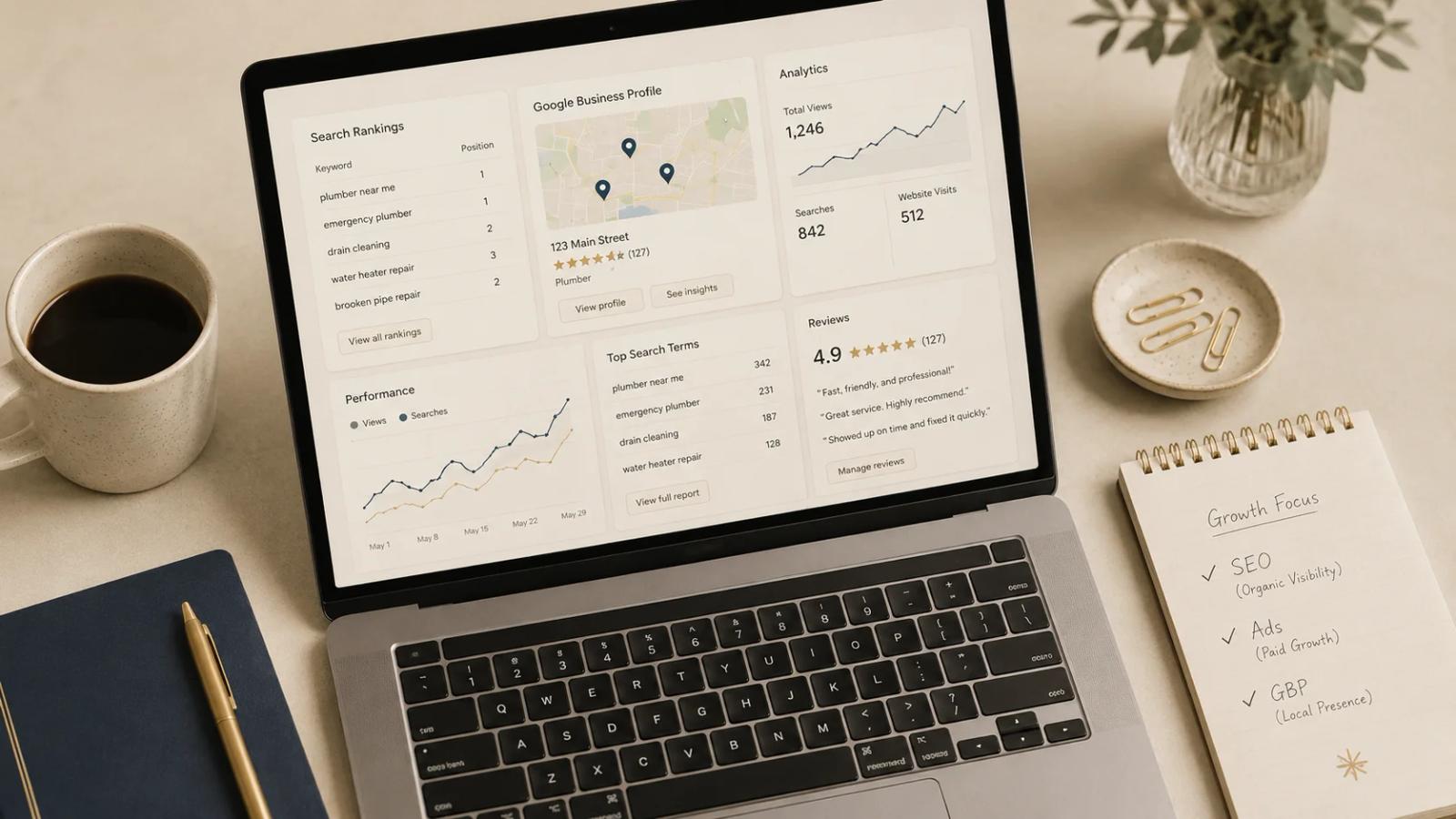
When a service-business owner searches for an "AI marketing agency," they're usually trying to cut through a specific kind of noise. Every agency right now claims some version of AI. The claims cover a wide range: automated content generation, AI-powered ad bidding, chatbot implementation, AI analytics dashboards.
Some of these are useful. Many are rebranded versions of tools that existed before "AI" became the word to use in agency pitches.
What a service business actually needs from an AI-informed agency is something different. Not AI as an automation shortcut. AI as a lens on how search behavior is changing, which businesses get found, and how to build marketing that works in the environment that now exists rather than the one from five years ago.
This article explains what that distinction looks like in practice, why it matters specifically for service businesses, and what to ask any agency claiming AI expertise before you hire them.
What Most Agencies Mean When They Say "AI"
The honest version of most agency AI claims goes something like this: they use AI tools to speed up content production, run their ad creative through optimization platforms that use machine learning, and may have added a chatbot or AI-assisted reporting layer to client dashboards.
These are legitimate tools. They've been reducing agency operating costs for the past two years, and the good ones improve output quality.
Generating blog posts faster with an AI writing tool doesn't change whether your business appears when someone asks ChatGPT to recommend a med spa in their city. Running AI-optimized Google Ads doesn't affect whether your HVAC company shows up in Google AI Overviews for "who should I call for emergency furnace repair."
Those are different problems, and they require different thinking.
The distinction is between using AI tools internally to produce marketing faster, and understanding how AI is changing how prospects find and choose service businesses. The first is an operational improvement. The second is a strategic one. Most agencies have the first. Fewer have meaningfully grappled with the second.
What AI Search Visibility Means for a Service Business
The business case for AI search visibility is no longer theoretical. A 2026 survey of 300 senior B2B decision-makers found 66% use AI tools to research suppliers before purchasing, 90% trust the recommendations, and 85% have discovered a new supplier through an AI response.
The buyer journey for appointment-driven service businesses is shifting the same way, just earlier in the adoption curve.
AI search visibility is the degree to which your business appears when people use AI systems to find services like yours. This includes Google AI Overviews (which appear above organic search results on an increasing share of queries), ChatGPT with browsing enabled, Perplexity, and voice assistants like Siri and Google Assistant.
The businesses appearing in those AI-generated answers are selected differently from the businesses that rank organically on Google.
In fact, when we tested the same query across four AI platforms simultaneously, each one named a different business as its primary recommendation – zero overlap between ChatGPT, Perplexity, and Gemini for the same city and vertical.
AI systems favor businesses with complete, consistent, structured data: a fully built-out GBP with specific service descriptions, citation consistency across major directories, and active review streams.
They also favor website content structured as direct question-and-answer pairs rather than flowing marketing prose. That's a content structure choice, not a budget choice.
For a service business, this matters because the queries AI systems handle well are exactly the ones your prospects use: "who should I call for X near me," "recommend a [service type] in [city]," "what's the best option for my situation."
These are high-intent, appointment-ready searches. The businesses not appearing in those answers are invisible to that segment of searchers, regardless of where they rank on Google — which is exactly why local SEO and AI visibility work best when they're built together.
How an AI-Integrated Approach Differs From Standard Agency Work
The practical differences between an AI-integrated content and local SEO approach and a standard one show up in a few specific places.
Content structure, not just content volume. Standard content marketing produces articles and service pages optimized for keyword rankings. An AI-aware approach adds a second layer: structuring that content in formats AI systems can parse and cite.
That means direct FAQ sections with plain-language answers, named entities throughout (specific services, specific cities, specific credentials), and schema markup that tells AI crawlers exactly where the quotable content is. The same volume of content, structured differently, can produce dramatically different AI citation rates.
GBP as a primary channel, not an afterthought. Most generalist agencies treat Google Business Profile as a one-time setup task. An agency that understands AI local search treats GBP as an ongoing channel.
Review velocity, category optimization, service entry completeness, and photo freshness all affect AI recommendations on a month-by-month basis. Managing GBP actively rather than setting it up once is a meaningful operational difference.
Monitoring across AI platforms, not just Google Search Console. Standard reporting tracks organic traffic, keyword rankings, and paid campaign performance. An AI-aware approach adds AI citation tracking: how often does your business appear in ChatGPT, Google AI Overviews, and Perplexity responses?
Tools like Ahrefs AI Mentions give you a baseline. Manual query testing gives you the qualitative picture. Most agencies aren't doing either.
Citation consistency as an active maintenance task. NAP consistency across directories affects both traditional local SEO rankings and AI recommendation confidence. Standard agency work might include a one-time citation audit.
AI-aware work includes monitoring for inconsistencies as your business evolves, since new location openings, rebrands, and phone number changes all create citation drift that suppresses AI recommendations over time.
Why Service Businesses Are Uniquely Positioned to Benefit
The conversion data backs this up. Seer Interactive found ChatGPT referral traffic converted at 15.9% and Perplexity at 10.5%, versus 1.76% for Google organic. Ahrefs found AI search visitors convert at roughly 23 times the rate of traditional organic visitors.
Both figures come from specific datasets and will vary by business, but the directional picture is consistent: AI-referred visitors arrive with high intent.
Service businesses have structural advantages in AI local search that SaaS companies and e-commerce brands don't.
Local intent is built into the query. When someone asks ChatGPT for a med spa recommendation in their city, the answer is almost always a real business with a local address. The signals that produce that recommendation, GBP completeness, local citations, review streams, are exactly what a local service business already has or can build.
There's no national brand with unlimited resources to out-GBP you.
Appointment-booking intent produces high-specificity queries. "I need an HVAC company that can come out this week" and "recommend a vet for a dog with allergies in Austin" are specific enough that AI systems lean heavily on local business data rather than general web authority.
That specificity favors the businesses with complete, accurate, current local data, which is attainable for any well-run service business regardless of marketing budget.
High-LTV clients make the investment rational. For a med spa, a law firm, or a veterinary practice, a single new client acquired through AI recommendations may generate thousands of dollars in lifetime value. The economics of investing in AI search visibility are more favorable for service businesses with high-LTV clients than for lower-margin businesses where the math works differently.
Five Questions to Ask Any Agency Before You Hire Them
One guardrail before the list: no agency can guarantee specific AI citation positions. SparkToro and Gumshoe research (2,961 prompts, November–December 2025) found a less-than-one-in-100 chance that the same brand list appears twice for the same prompt. Any agency selling "guaranteed #1 in ChatGPT" is selling something that doesn't exist.
What legitimate AI visibility work produces is a higher frequency of appearances across many queries, not a fixed position.
If you're evaluating agencies and "AI" is part of how they're positioning themselves, here are the questions that separate agencies with substance from agencies with a slide deck.
- How do you optimize for Google AI Overviews specifically? A credible answer covers structured content, FAQ schema, and GBP completeness as distinct work items. An answer that conflates AI Overviews with standard SEO or talks about AI tools for content generation is the wrong answer to a different question.
- How do you track AI citation performance? Specifically: do you use Ahrefs AI Mentions, do you run manual ChatGPT and Perplexity query testing, and how do those metrics appear in your reporting? An agency that can't answer this question concretely isn't tracking AI visibility at all.
- What's your approach to Google Business Profile as an ongoing channel? The answer should include review velocity, category and attribute optimization, service entry management, and photo cadence. An answer that treats GBP as a one-time setup task signals that the agency is operating with an older local SEO playbook.
- Can you walk me through how you'd structure a service page to be AI-citation-friendly? The answer should include FAQ sections, named entities, specific service and location descriptions, and schema markup. An agency that only talks about keyword density and word count is optimizing for traditional search, not AI visibility.
- How do you think about the difference between AI visibility for local businesses and AI visibility for national brands? This question probes whether the agency understands local search specifically, or whether they're applying a generalist AI framework to a problem that is fundamentally local.
What This Looks Like in Practice at Lunova
Lunova Growth Marketing Agency is a boutique, founder-led agency built specifically for US service businesses. We run the full marketing operation — paid ads, SEO, content, and email — under one retainer, so busy founders aren't managing five separate vendors or coordinating five separate briefings every month.
There's no long-term lock-in: our engagements are month-to-month, so you stay because the work is producing results, not because you signed a contract that holds you there. That structure puts the accountability on us, not on you.
AI search visibility is built into how we work, not added as a separate service. Every piece of content we produce is structured for AI citation alongside keyword ranking. GBP management is ongoing, not a setup task we hand back. Google AI Overviews appearances and ChatGPT citation monitoring are part of the standard reporting.
For service businesses that want to understand the full scope, the AI visibility service page covers each tier in detail. For the underlying mechanics, the guides on showing up in ChatGPT and on getting cited by AI are worth reading first.
One honest note: Lunova is a newer agency. We don't have years of published case studies. What we do have is a senior team with a documented track record from prior work, a playbook built specifically for the acquisition model service businesses share, and a month-to-month structure that means the results have to speak for themselves.
The clearest next step is knowing where your business stands. Reach out to Lunova Growth Marketing Agency today, and our free Growth Audit will cover your AI citation gaps alongside your broader local SEO picture. You'll have a specific set of findings within a few days, with no obligation on either side.
Frequently Asked Questions
What does an AI marketing agency do?
What an AI marketing agency does varies significantly depending on how the agency is using "AI." At the operational level, most agencies use AI tools to speed up content production, optimize ad campaigns through machine-learning platforms, and generate analytics insights.
At the strategic level, a smaller number of agencies focus on AI search visibility: understanding how AI systems are changing how prospects find businesses, and building the content structure, GBP optimization, and citation management that produce AI recommendations.
For a service business, the second type produces the most meaningful new-client impact.
Is AI marketing relevant for small service businesses?
AI marketing is relevant for small service businesses, particularly the AI search visibility component. Small service businesses with complete, active GBPs, consistent directory citations, and structured website content are already competitive in AI local recommendations because those are data-quality signals, not budget signals.
A well-run med spa, vet clinic, or HVAC company can appear in ChatGPT and Google AI Overview recommendations ahead of larger competitors that haven't paid attention to these signals. The investment required is real but not prohibitive, and the high-LTV client economics of most service businesses make it worthwhile.
How is AI marketing different from regular digital marketing?
AI marketing is different from regular digital marketing primarily in how it understands the discovery layer. Traditional digital marketing optimizes for Google organic rankings, paid search, and social reach. AI marketing adds a fourth channel: AI-generated answers and recommendations.
The signals that produce visibility in that fourth channel overlap with traditional local SEO but diverge in content format (direct FAQ structure over flowing prose), schema markup requirements (FAQ schema for AI citation), and monitoring approach (AI citation tracking alongside keyword rankings).
An agency doing only traditional digital marketing is optimizing for a version of discovery that is becoming less complete each year.
Does an AI marketing agency replace my need for traditional SEO?
An AI marketing agency does not replace your need for traditional SEO. The two are complementary rather than substitutes. Traditional local SEO builds the foundation that AI visibility depends on: a technically sound website, a complete GBP, clean citation profiles, and content that ranks for your primary keywords.
AI visibility work adds the layer that converts that foundation into AI citations: structured content, FAQ schema, named entity consistency, and active monitoring across AI platforms. Running one without the other leaves either traditional search visibility or AI visibility incomplete. The agencies worth working with understand both and build for both simultaneously.
What should I ask an AI marketing agency before hiring them?
Before hiring an AI marketing agency, ask how they optimize specifically for Google AI Overviews and what that process looks like in practice. Ask how they track AI citation performance, including whether they use tools like Ahrefs AI Mentions and whether manual ChatGPT and Perplexity testing is part of their monitoring.
Ask how they approach Google Business Profile as an ongoing managed channel rather than a one-time setup. Ask them to walk you through how they'd structure a service page for AI citation. And ask how their AI visibility approach differs for local service businesses specifically versus national brands. The answers will tell you quickly whether the agency has substance behind the positioning.